
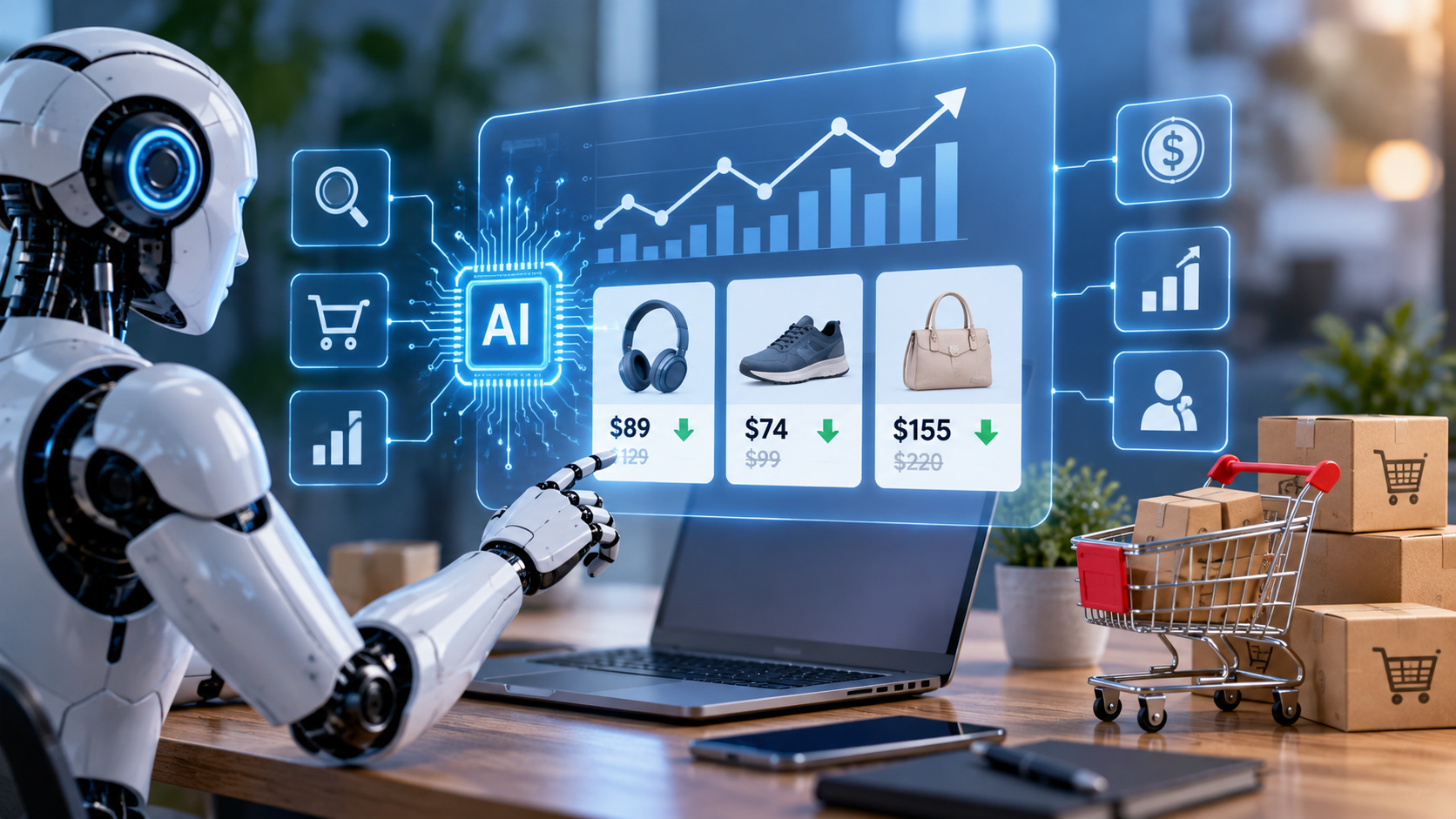
Pricing has always been one of the most consequential decisions in retail. Set it too high and customers walk away. Set it too low and you leave money on the table. For most of e-commerce history, pricing was guided by manual research, fixed margin rules, and periodic competitive reviews. That approach worked when markets moved slowly. It doesn’t work anymore.
AI algorithms have fundamentally changed the calculus. They process thousands of variables simultaneously, update prices in real time, and learn continuously from outcomes. The result is a level of pricing precision that manual methods simply cannot match. But with that power comes complexity — and real risks that businesses using AI pricing tools need to understand.
How AI Algorithms Actually Determine Prices
AI pricing isn’t magic — it’s pattern recognition applied to pricing decisions. The algorithms draw on multiple data inputs and weigh them against each other to calculate an optimal price at any given moment.
Demand Forecasting
Machine learning models analyze historical sales data to forecast future demand. They account for seasonality, day of week, time of day, weather patterns, and recent trend shifts. If demand for a product is projected to spike — because of an upcoming holiday, a viral trend, or a weather event — the algorithm can recommend a price increase to capture that demand at higher margin.
The same works in reverse. A product with declining demand may trigger automatic price reductions to clear inventory before it becomes a dead stock problem.
Competitor Price Monitoring
AI-powered competitor monitoring tools scan rival websites continuously, tracking price changes across thousands of SKUs. The algorithm then feeds these competitive signals into the pricing model, allowing a retailer to stay within a target range relative to competitors — whether that means matching, undercutting, or holding a premium position.
Amazon has long used this approach to maintain competitive pricing across its catalog, with prices on some products changing multiple times per day in response to competitor activity and demand signals.
Customer Behavior and Willingness to Pay
This is where AI pricing gets more sophisticated — and more controversial. By analyzing browsing history, purchase patterns, cart abandonment rates, and even device type, algorithms can model what different customer segments are willing to pay for the same product.
A user who has browsed a product multiple times and regularly shops at premium price points may see a different price than a first-time visitor arriving from a price-comparison site. This is known as personalized or segmented pricing, and it is common in sectors like airlines, hotels, and subscription software.
Inventory and Supply Chain Signals
AI pricing algorithms increasingly integrate with inventory management systems. When stock levels are high, the model may suggest promotional pricing to accelerate sell-through. When a product is nearly out of stock and cannot be replenished quickly, it may recommend holding or raising the price to manage remaining units.
Retailers using this approach can reduce both overstock (which ties up capital) and stockouts (which drive customers to competitors).
Promotional and Bundle Optimization
AI also optimizes discounts and promotional pricing. Rather than applying blanket percentage-off promotions, algorithms identify which products benefit most from discounts in terms of incremental revenue, what discount depth drives conversion without destroying margin, and which product combinations work best as bundles. This makes promotions more targeted and more profitable than traditional blanket sales.
The Real Benefits for E-Commerce Businesses
When implemented well, AI pricing algorithms deliver concrete advantages:
- Margin protection — Pricing responds to cost changes and demand shifts faster than any human review process, reducing the time products are priced below their optimal point.
- Competitive responsiveness — Real-time competitor monitoring means a business never goes to sleep while a rival undercuts it for hours undetected.
- Revenue uplift — Capturing higher prices when demand is strong, and driving volume when demand softens, improves overall revenue performance across a catalog.
- Reduced manual workload — For businesses with large catalogs, manually reviewing and adjusting prices is impractical. AI handles this at scale, freeing pricing teams to focus on strategy rather than execution.
- Smarter promotions — AI eliminates the guesswork from discount decisions, directing promotional spend toward the products and segments where it generates the most return.
Airbnb, while primarily a platform rather than a retailer, demonstrates how sophisticated AI pricing works in practice. Its pricing algorithm accounts for local events, lead time, comparable listing rates, historical occupancy, and real-time demand — helping hosts optimize nightly rates without constant manual adjustment.
The Risks and Challenges That Cannot Be Ignored
AI-powered pricing is not without serious downsides. Businesses that overlook these risks do so at significant cost — to their customers and to themselves.
Pricing Fairness and Discrimination
Personalized pricing based on customer data raises genuine fairness concerns. If pricing models produce different prices based on factors that correlate with protected characteristics — income proxies, location, device type — they may create discriminatory outcomes even without intending to. This is an active area of regulatory scrutiny in several jurisdictions.
Transparency and Customer Trust
Customers who discover they paid more than someone else for the exact same product — at the same time — typically react with anger and a loss of trust. While variable pricing is legally permissible in most markets, the discovery moment can generate significant reputational damage.
Businesses using personalized pricing should consider how they would explain their pricing approach to a customer who asks directly. If the answer is uncomfortable, the approach may need rethinking.
Algorithmic Errors and Price Spirals
Automated pricing systems can interact with each other in ways that produce unintended results. Two competing retailers with aggressive price-matching algorithms can trigger a race to the bottom — each undercutting the other in an automated loop — until prices drop to levels neither business intended. Similar dynamics can push prices dramatically upward when algorithms incorrectly signal scarcity or high demand.
These errors are not hypothetical. Cases of algorithmic pricing anomalies — products listed at wildly irrational prices — have been documented across major platforms.
Privacy and Data Use
Personalized pricing requires significant customer data. Collecting and using that data carries obligations under privacy regulations including GDPR and CCPA. Businesses need clear data governance policies, proper consent mechanisms, and an understanding of what data is actually being fed into their pricing models.
Using AI Pricing Responsibly
The businesses getting the most long-term value from AI pricing are those treating it as a tool that requires human judgment alongside automation — not a system to run unchecked.
Set clear guardrails. Define minimum and maximum price boundaries for every product category. No algorithm should be able to price a product below cost or at a level that would trigger a customer or regulatory backlash without a human review trigger.
Audit outputs regularly. Review pricing decisions periodically to identify patterns that may indicate bias, errors, or unintended competitive dynamics.
Be selective about personalization. Using behavior to offer targeted promotions is generally well-received. Using it to charge demonstrably different prices for the same item at the same moment requires more careful ethical and legal consideration.
Test and learn. Treat pricing experiments as structured tests with measurable outcomes, rather than permanent automated decisions. This builds understanding of what works and maintains human visibility over the system.
Zara’s approach to inventory-driven pricing — using data signals to inform markdown timing rather than implementing personalized price discrimination — illustrates how AI pricing can be powerful without being opaque or unfair to customers.
Conclusion
AI algorithms in e-commerce pricing represent a genuine competitive advantage for businesses that deploy them thoughtfully. They enable faster responses to market conditions, smarter promotional decisions, and margin optimization at a scale that manual processes cannot achieve. But the same capabilities that make these systems powerful also create real risks — to fairness, to customer trust, and to pricing integrity.
The businesses that will benefit most are those that combine AI’s analytical horsepower with human oversight, clear ethical boundaries, and a genuine commitment to pricing transparency. The technology is sophisticated. The strategy behind it still needs to be human.
Frequently Asked Questions
Q1: What are AI algorithms in e-commerce pricing?
They are machine learning and predictive analytics systems that analyze market data, customer behavior, competitor prices, and inventory levels to calculate and adjust product prices automatically and in real time.
Q2: What is dynamic pricing in e-commerce?
Dynamic pricing is when a product’s price changes based on real-time factors such as demand, competitor prices, time of day, or inventory levels — rather than remaining fixed. AI makes this possible at scale across large catalogs.
Q3: Is personalized pricing legal?
In most markets, yes — but it is subject to anti-discrimination laws and privacy regulations. Pricing that produces discriminatory outcomes based on protected characteristics, even unintentionally, can create legal and reputational exposure.
Q4: Can small e-commerce businesses use AI pricing tools?
Yes. Tools like Prisync, Wiser, and Omnia Retail offer AI-powered pricing capabilities for businesses of various sizes, making competitive monitoring and dynamic pricing accessible beyond enterprise-level retailers.
Q5: How can businesses prevent AI pricing errors?
By setting hard price guardrails (minimum and maximum boundaries), monitoring algorithm outputs regularly, running pricing changes as structured experiments, and maintaining human review triggers for unusual price movements.
Leave a Reply