
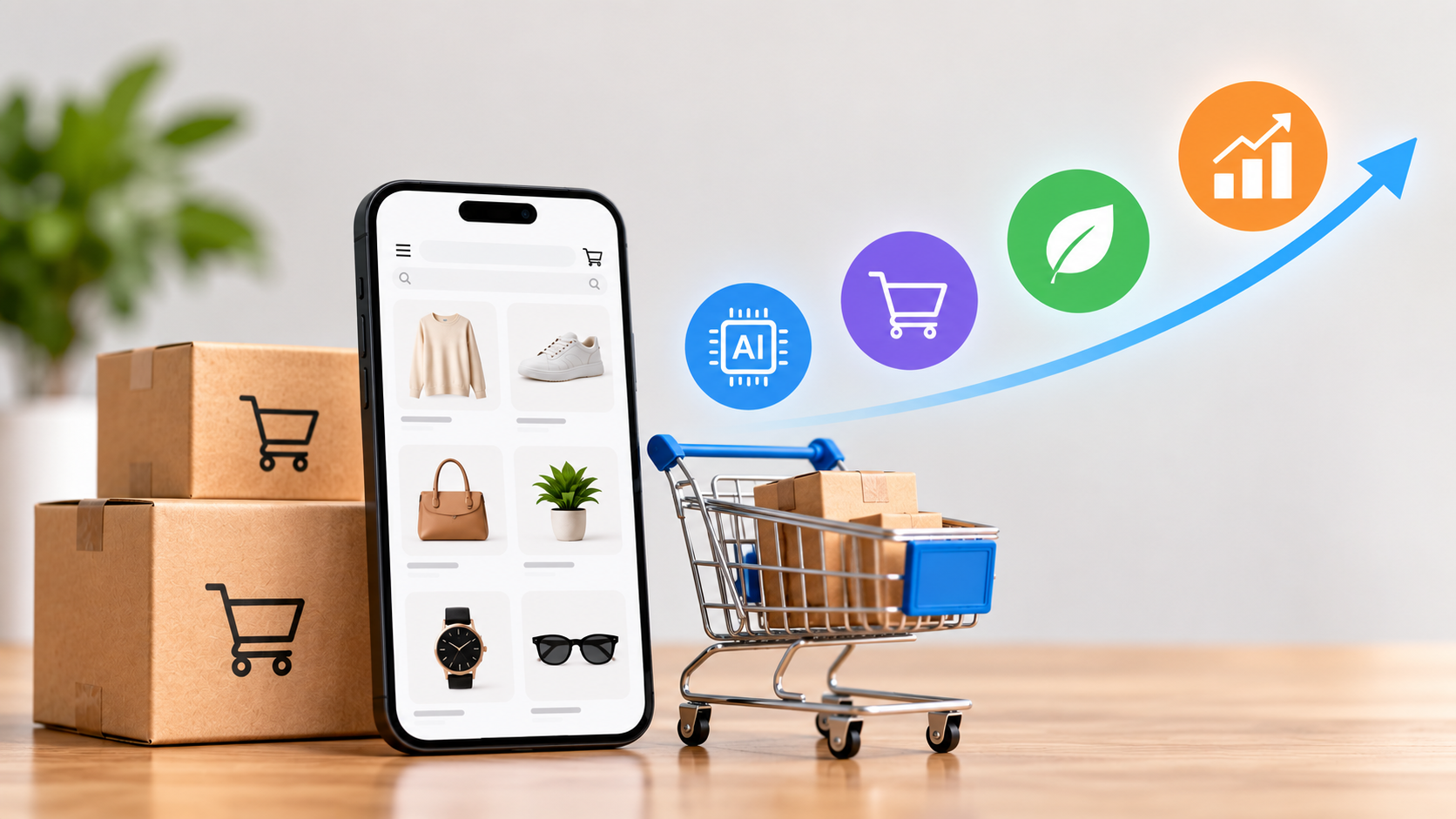
E-commerce is not standing still. The combination of more capable artificial intelligence, faster payment infrastructure, and shifting consumer behaviour is producing a wave of technology adoption that is changing how people discover, evaluate, and buy products online. Some of these shifts are already visible. Others are just beginning to surface at the edges of the industry.
This article covers the most significant e-commerce technology trends in 2026 — what they are, how they affect shoppers and businesses, and what practical steps e-commerce operators should be taking now to stay ahead.
1. AI-Powered Shopping and Personalisation at Scale
Artificial intelligence has been a feature of e-commerce for years, but its role has matured considerably. In 2026, AI in e-commerce goes well beyond basic product recommendations. Retailers are now using AI to adapt the entire shopping experience — homepage layout, search results, promotional messaging, pricing — in real time based on individual shopper behaviour, location, device, and purchase history.
For shoppers, this means seeing fewer irrelevant products and more of what they are actually likely to buy. For businesses, it means higher average order values, improved conversion rates, and reduced browse abandonment — without needing to manually curate experiences for every customer segment.
The challenge is data. Effective AI personalisation depends on rich, accurate first-party data. Businesses that have not invested in collecting and organising customer data are at a structural disadvantage as third-party cookie tracking continues to be phased out across major browsers.
2. AI Agents Handling the Full Purchase Journey
Beyond static personalisation, AI agents in e-commerce are emerging as autonomous assistants that can manage the entire purchase journey on a shopper’s behalf. Instead of manually searching for a product, comparing options, and checking out, a shopper can brief an AI agent — through text or voice — which then finds options, evaluates them against criteria like price, delivery speed, and reviews, and completes the purchase.
This is not purely theoretical. Early versions are already visible in voice-activated shopping, browser-embedded assistants, and AI-powered shopping apps. As agent capabilities improve, the implication for e-commerce businesses is significant: if a significant portion of purchases are made through AI intermediaries rather than direct browsing, then product data quality, structured data formats, and review reputation become more important than traditional on-page design.
3. Augmented Reality and Visual Shopping
AR shopping addresses one of the oldest friction points in online retail: shoppers cannot physically try or place products before buying. Augmented reality closes this gap by overlaying digital product visualisations onto real-world environments through a phone camera or AR glasses.
Practical applications in 2026 include:
- Furniture and home decor: visualising how a sofa or lamp looks in your actual room before purchasing
- Fashion: virtual try-on for clothing, eyewear, and footwear using body tracking
- Beauty: testing makeup shades and skincare products through face-mapped overlays
- DIY and hardware: previewing how a paint colour or flooring option looks in a specific space
Retailers investing in AR experiences consistently report lower return rates for the product categories where it is deployed — a meaningful commercial benefit given that returns processing is one of the most costly logistics challenges in e-commerce.
4. Social Commerce Moving Into the Mainstream
Social commerce — purchasing directly within social media platforms without leaving the app — has been building momentum for several years. In 2026, it is no longer an experimental channel. TikTok Shop, Instagram Shopping, and Pinterest’s buyable pins have matured into genuine revenue channels for brands across fashion, beauty, food, and consumer electronics.
What makes social commerce distinct from traditional e-commerce is discovery. Purchases on social platforms are often impulse-driven, triggered by a piece of content — a short video demonstration, a creator recommendation, a live shopping broadcast — rather than a deliberate product search. This demands a different approach to content strategy, creator partnerships, and product presentation compared to standard search-driven traffic.
For smaller businesses, social commerce offers an accessible entry point into selling without requiring a fully built e-commerce store. For established retailers, it represents an additional acquisition channel that connects product discovery directly to the point of purchase.
5. Conversational Commerce and AI Chat
Customers increasingly expect immediate, accurate answers before committing to a purchase. Conversational commerce meets this expectation through AI-powered chat — either embedded on a retailer’s website or operating through messaging platforms like WhatsApp and Instagram DMs.
Modern AI chat tools can handle product queries, help shoppers choose between options, process order status requests, manage simple returns, and escalate to a human agent when needed. Done well, conversational commerce reduces the friction between intent and purchase without adding proportional customer service headcount.
The risk is poor implementation. Chatbots that fail to understand queries or loop shoppers in unhelpful responses actively damage trust and increase abandonment. The gap between a well-configured AI commerce assistant and a poorly built chatbot is significant — and shoppers notice the difference immediately.
6. Faster and More Flexible Digital Payments
Payment technology continues to evolve in ways that directly affect checkout conversion. Key developments shaping e-commerce trends in 2026 on the payments side include:
- Buy Now, Pay Later (BNPL): Embedded instalment payments are now expected across many retail categories, particularly for higher-value purchases. Their presence at checkout measurably increases conversion for price-sensitive shoppers.
- One-click and biometric checkout: Stored payment credentials combined with fingerprint or face authentication are compressing multi-step checkouts into single-step completions.
- Digital wallets: Apple Pay, Google Pay, and regional equivalents now handle a substantial proportion of mobile transactions in many markets. Retailers not supporting the dominant wallet for their primary markets are losing conversions.
- Real-time account-to-account payments: Emerging in markets with strong open banking infrastructure, these allow direct bank transfers at checkout without card network fees — reducing cost for merchants.
7. Smart Supply Chains and Predictive Inventory
Inventory management errors — being overstocked in slow products or understocked in fast movers — are among the most expensive operational mistakes in e-commerce. AI-powered demand forecasting and smart supply chain tools are making these errors less frequent by processing historical sales data, seasonal patterns, marketing calendar inputs, and external signals to predict demand more accurately.
At the logistics end, route optimisation algorithms are reducing last-mile delivery costs, while automated warehouse systems — including robotics at larger scale — are improving pick-and-pack speed and accuracy. For mid-market e-commerce businesses, third-party fulfilment partners with embedded AI are making these capabilities accessible without requiring in-house infrastructure investment.
8. Privacy, Security, and Trust as Competitive Differentiators
As personalisation deepens and data collection expands, shopper concerns about privacy and data security are rising in parallel. Regulatory environments — GDPR in Europe, state privacy laws in the US, and equivalents emerging in other markets — are tightening the rules around data collection, consent, and retention.
Businesses that handle this well — transparent data practices, clear consent mechanisms, minimal data collection, and strong security posture — are increasingly earning a trust premium with privacy-conscious shoppers. Those that treat data compliance as a box-ticking exercise rather than a genuine customer commitment face both regulatory exposure and reputational risk.
What E-Commerce Businesses Should Do Next
The breadth of these trends can feel overwhelming, but the practical priorities are relatively clear:
- Audit your first-party data strategy: If you depend on third-party data for personalisation, build the infrastructure to collect and use first-party data before that window closes further.
- Evaluate AI tools with a clear use case: AI adoption is most effective when it solves a specific, measurable problem — not when it is adopted for its own sake.
- Optimise for mobile and social commerce: If your checkout and product pages are not fully optimised for mobile and social discovery, fixing this delivers more immediate return than most advanced technology investments.
- Invest in product data quality: As AI agents and visual search become more prominent, structured, rich product data is increasingly the foundation that makes everything else work.
- Review payment options: Ensure your checkout supports the payment methods your core customer base prefers — gaps here are direct revenue losses.
Conclusion
The future of e-commerce in 2026 is being shaped by technologies that, in most cases, are already deployable — not distant possibilities. AI-driven personalisation, autonomous shopping agents, augmented reality try-on, social commerce, and smarter supply chains are all in active use by retailers at various scales today.
The advantage goes to businesses that adopt these tools thoughtfully — with clear objectives, strong data foundations, and genuine attention to customer trust. The technology is moving fast enough that waiting for certainty is itself a strategic risk. The right approach is to start with the highest-impact areas for your specific customer base, test systematically, and build outward from there.
Frequently Asked Questions (FAQs)
1. What is the biggest technology trend in e-commerce in 2026?
AI-powered personalisation and AI shopping agents are among the most impactful trends, reshaping how shoppers discover and purchase products. However, social commerce and AR shopping are also seeing significant adoption across retail categories.
2. How is AI changing the e-commerce shopping experience?
AI is changing e-commerce by enabling real-time personalisation of product recommendations, search results, and pricing — and increasingly through AI agents that can handle product discovery and purchase completion autonomously on behalf of shoppers.
3. What is social commerce and why does it matter?
Social commerce is the ability to purchase products directly within social media platforms without leaving the app. It matters because it connects product discovery — driven by content and creator recommendations — directly to the point of purchase, reducing friction and enabling impulse-driven buying at scale.
4. What challenges do e-commerce businesses face when adopting new technology?
Key challenges include implementation costs, the need for quality first-party data, customer privacy and trust concerns, integration with existing systems, and the difficulty of evaluating which technologies will deliver a genuine return for a specific business model.
5. How should a small e-commerce business approach these technology trends?
Small businesses should prioritise the trends most directly relevant to their customer base and current gaps — typically mobile checkout optimisation, social commerce presence, and AI-powered product recommendations — before investing in more complex implementations like AR or autonomous AI agents.
Leave a Reply