
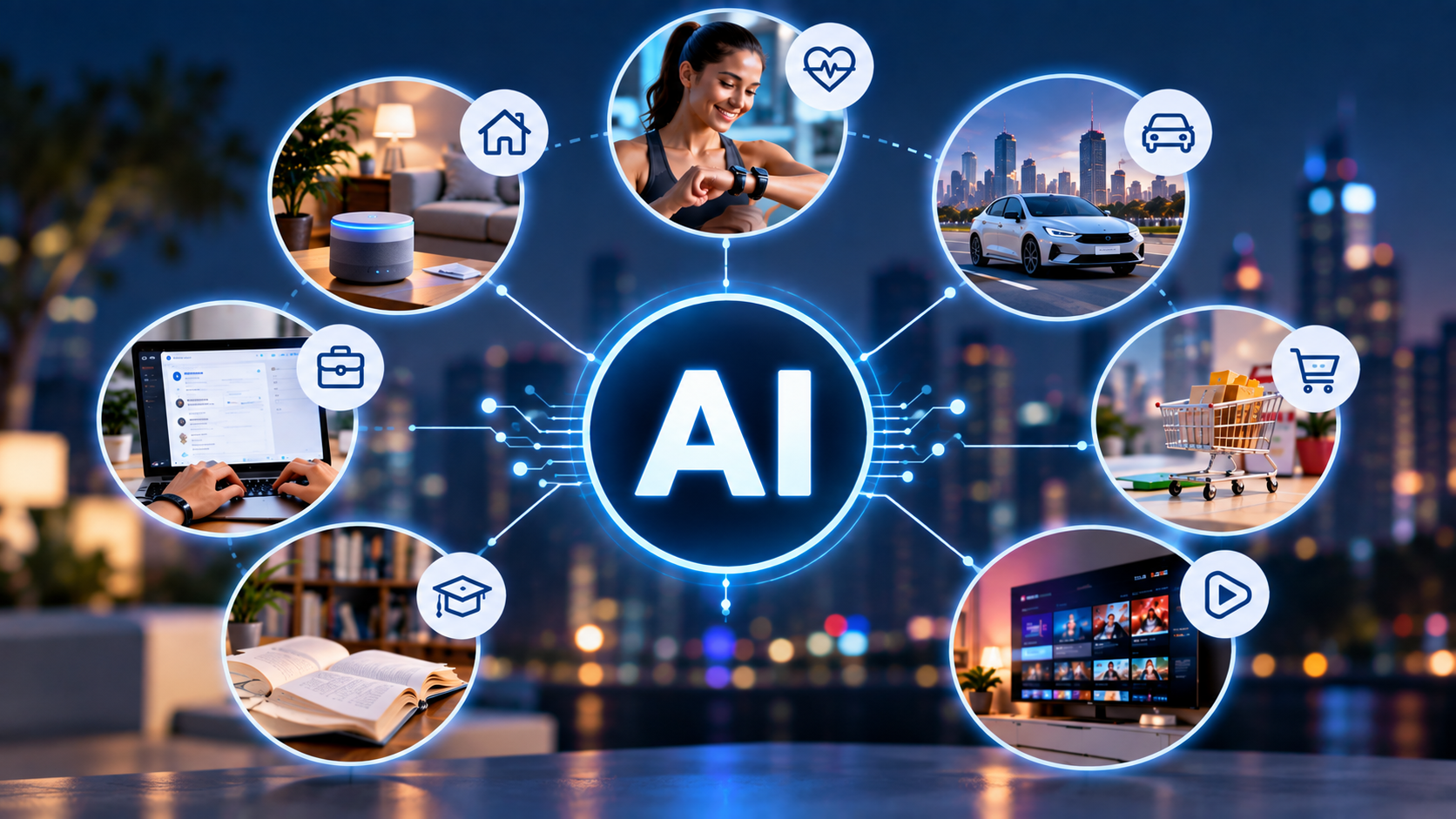
A decade ago, artificial intelligence felt like something out of a sci-fi movie. Today, it’s the invisible engine running quietly behind your morning alarm, your grocery list, your doctor’s diagnosis, and even the show you binge-watched last night. By 2026, AI isn’t a “feature” anymore — it’s the default way technology behaves.
This shift hasn’t happened with a bang. It’s happened gradually, one small convenience at a time, until suddenly we’re living in a world where our devices anticipate what we need before we ask. Let’s take a closer look at where AI has embedded itself into daily life — and where it’s headed next.
1. Smartphones Have Become Personal Thinking Machines
Smartphones were once just communication tools. Now they’re AI companions that learn your habits.
- On-device AI chips process photos, translate speech, and summarize messages instantly, without sending data to the cloud
- Predictive typing and writing tools now understand context and tone, not just grammar
- Battery and app management is handled automatically, with AI learning your usage patterns to extend battery life
- Camera systems use AI to recognize scenes, adjust lighting, and remove unwanted objects in real time
The biggest shift in 2026 is privacy-friendly, on-device processing. Instead of relying entirely on cloud servers, more AI tasks now run locally on your phone, which means faster results and less personal data floating around online.
Why This Matters
For everyday users, this means less time fiddling with settings and more time getting things done — your phone increasingly just knows what you want.
2. Smart Homes Are Finally Living Up to the Hype
For years, “smart homes” meant a pile of disconnected gadgets that barely talked to each other. That’s changing fast.
With wider adoption of unified smart home standards, devices from different brands now work together seamlessly. Your thermostat, lights, security cameras, and voice assistant can finally operate as one coordinated system rather than isolated apps.
What smart homes now handle automatically:
- Adjusting temperature based on weather forecasts and occupancy
- Detecting unusual activity and alerting homeowners in real time
- Learning routines to switch lights and appliances on or off without a single command
- Reducing energy waste by optimizing usage during off-peak hours
Instead of programming a home, you simply live in it — and the system adjusts around you.
3. Online Shopping Feels Increasingly Personal
E-commerce has quietly become one of the biggest AI success stories. Retailers now use machine learning to predict what shoppers want before they even search for it.
- Personalized recommendations go beyond “customers also bought” and factor in browsing behavior, past purchases, and even seasonal trends
- AI-powered chat support resolves order issues instantly, without long wait times
- Virtual try-on tools let shoppers preview clothing, makeup, or furniture using their own photos or room layouts
- Dynamic pricing and inventory tools help retailers avoid stockouts while offering more competitive deals
The result is a shopping experience that feels less like browsing a catalog and more like getting advice from someone who actually knows your taste.
4. Healthcare Is Becoming Faster and More Predictive
Perhaps nowhere is AI’s impact more meaningful than in healthcare, where speed and accuracy can be life-changing.
Diagnosis and Treatment
AI tools now assist doctors in reading scans, flagging early signs of disease, and comparing symptoms against massive medical datasets in seconds rather than hours.
Everyday Health Monitoring
Wearable devices have evolved far beyond step counters. Many now track:
- Heart rhythm irregularities
- Sleep quality and recovery patterns
- Blood oxygen and stress levels
- Early warning signs for chronic conditions
These devices don’t replace doctors — but they give both patients and physicians a much clearer, continuous picture of health, rather than a single snapshot during an annual checkup.
5. Cybersecurity Has Become an AI-vs-AI Battle
As AI makes life easier, it’s also made cybercrime more sophisticated — which means defense had to evolve too.
How AI strengthens everyday security:
- Detecting unusual login attempts or spending patterns in real time
- Identifying phishing emails and scam messages before they reach your inbox
- Spotting deepfake audio or video used in fraud attempts
- Automatically patching software vulnerabilities faster than human teams could alone
At the same time, bad actors are using AI to create more convincing scams, which is why 2026 has seen a sharp rise in AI-powered fraud detection tools built directly into banking apps, browsers, and email platforms. It’s an ongoing arms race — and AI is now essential on both sides.
6. Entertainment Is More Tailored Than Ever
Streaming platforms, music apps, and gaming services have leaned heavily into AI-driven personalization.
- Recommendation engines now factor in mood, time of day, and even how long you typically watch before switching content
- AI-generated background music and sound design are being used in games and video production to cut costs and speed up creation
- Real-time subtitle generation and translation make global content instantly accessible
- Adaptive difficulty in video games adjusts challenge levels based on player skill, keeping experiences engaging without frustration
The line between “recommended content” and “content made specifically for you” is blurring quickly.
7. Digital Assistants Are Becoming Proactive, Not Reactive
Older voice assistants waited for commands. The newer generation anticipates needs.
Instead of simply answering “What’s the weather?”, today’s assistants might notice you have an early meeting, check traffic conditions, and suggest leaving ten minutes earlier — without being asked. They coordinate calendars, manage smart home devices, filter notifications, and even draft replies to routine messages.
This shift from reactive to proactive assistance is one of the clearest signs of how far conversational AI has come.
What Comes Next: The Near Future of Everyday AI
Looking beyond 2026, a few trends are likely to accelerate:
- Multi-device AI ecosystems where your phone, car, home, and wearables share context seamlessly
- More on-device processing, reducing reliance on cloud servers and improving privacy
- AI agents that complete multi-step tasks, like booking travel or managing subscriptions, with minimal input
- Stricter regulation and transparency requirements, as governments respond to concerns about data privacy, bias, and deepfakes
- Healthcare AI moving from diagnostic support to genuinely predictive, personalized medicine
The technology will keep getting quieter and more woven into daily routines — the biggest changes may be the ones you barely notice happening.
Final Thoughts
AI in 2026 isn’t about robots or dramatic sci-fi transformations. It’s about smarter phones, homes that anticipate your needs, shopping that feels personal, healthcare that catches problems earlier, and digital tools that quietly handle the busywork of daily life.
The everyday convenience we now take for granted — a phone that manages its own battery, a home that adjusts itself, an assistant that plans ahead — is the clearest sign of how deeply AI has integrated into modern life. And if the current pace of innovation is any indication, this is just the beginning.
Leave a Reply