
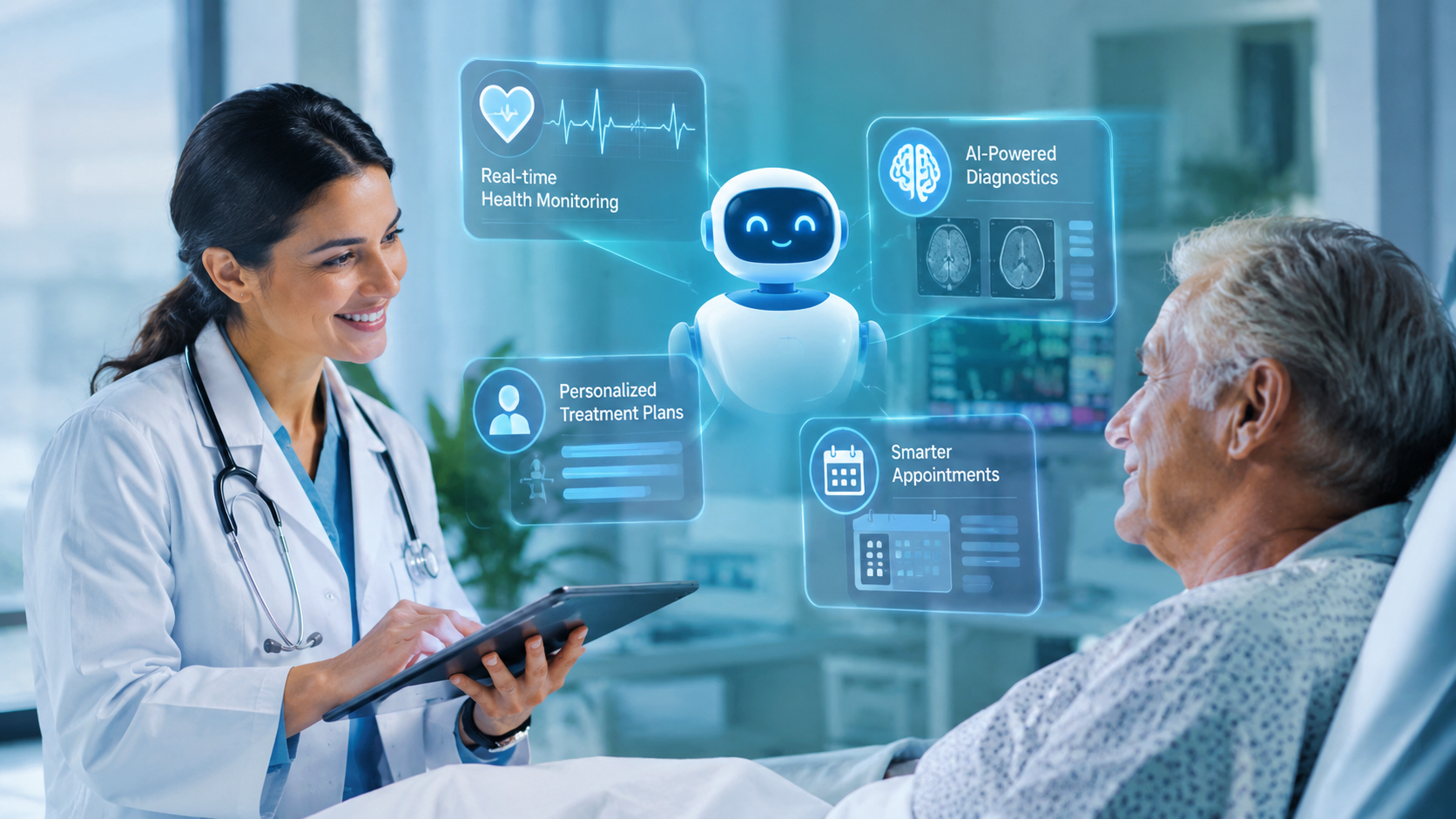
Healthcare is undergoing one of the most significant technological shifts in its history. Artificial intelligence in healthcare is no longer a distant concept — it’s already influencing how doctors diagnose disease, how hospitals manage resources, and how patients experience care. From AI-powered diagnosis tools to predictive healthcare models, the technology is quietly becoming part of everyday clinical practice.
This shift isn’t about replacing medical professionals. It’s about giving them better tools to make faster, more informed decisions. Below, we explore how AI in patient care is evolving, where it delivers real value, and where caution is still essential.
Why AI Is Gaining Ground in Healthcare
Healthcare systems worldwide face similar pressures: rising patient volumes, staff shortages, complex data, and the need to reduce costs without sacrificing quality. Artificial intelligence in healthcare addresses several of these pressures simultaneously by processing large volumes of medical data faster than manual methods allow, and by surfacing patterns that might otherwise go unnoticed.
This is why healthcare AI technology has expanded across so many areas of medicine — from diagnostics to hospital administration — rather than staying confined to a single use case.
AI-Powered Diagnosis and Medical Imaging
One of the most visible applications of AI diagnosis is in radiology and pathology. Machine learning models trained on medical images can help identify abnormalities in X-rays, CT scans, and MRIs, flagging areas that warrant closer review by a radiologist.
Practical applications include:
- Early detection support — highlighting suspicious patterns in imaging that may need further investigation
- Workflow prioritization — helping radiologists triage urgent cases first
- Consistency checks — reducing variability in how images are reviewed across different readers
Importantly, these systems function as decision support, not replacements for trained specialists. A radiologist or pathologist still reviews findings and makes the final call.
Personalized Medicine and Predictive Healthcare
Personalized medicine is one of the more promising directions for AI in patient care. By analyzing a patient’s medical history, genetic information, and lifestyle factors, AI models can help clinicians tailor treatment plans rather than relying solely on generalized protocols.
Closely related is predictive healthcare, which uses historical and real-time data to estimate a patient’s risk of developing certain conditions or experiencing complications. Hospitals have started using predictive models to:
- Flag patients at higher risk of readmission
- Identify early warning signs of clinical deterioration
- Support proactive rather than reactive care
When used responsibly, this approach can shift healthcare from treating illness after the fact to intervening earlier — though outcomes still depend heavily on data quality and clinical judgment.
Virtual Health Assistants and Remote Patient Monitoring
AI-powered healthcare isn’t limited to hospital settings. Virtual health assistants — chatbots and voice-based tools — now help patients schedule appointments, understand medication instructions, and get answers to routine questions without waiting on hold.
Remote patient monitoring is another growing area. Wearable devices and connected sensors can track vital signs such as heart rate, blood glucose, or oxygen levels, sending data to care teams in real time. This is particularly valuable for:
- Managing chronic conditions like diabetes or hypertension
- Monitoring recovery after surgery from home
- Reducing unnecessary hospital visits for stable patients
These tools extend care beyond clinic walls, giving both patients and providers more continuous visibility into health status.
AI in Drug Discovery
Developing new medications traditionally takes years and substantial investment. AI is helping accelerate parts of this process by analyzing molecular data to identify promising drug candidates, predict how compounds might behave, and narrow down options before expensive lab testing begins.
While AI doesn’t eliminate the need for clinical trials or regulatory review, it can help researchers focus their efforts more efficiently in the early stages of drug development.
Administrative Automation and Clinical Decision Support
Not all impactful uses of AI happen at the bedside. A significant portion of healthcare costs and staff time goes toward administrative tasks — scheduling, billing, insurance claims, and documentation.
AI-driven automation is helping reduce this burden by:
- Streamlining medical coding and billing accuracy
- Automating appointment reminders and follow-ups
- Assisting with clinical documentation, freeing up time for patient interaction
Clinical decision support systems complement this by analyzing patient data against established guidelines, alerting physicians to potential drug interactions, or suggesting relevant tests based on symptoms. These systems are designed to inform, not override, professional judgment.
Benefits for Patients, Doctors, and Healthcare Organizations
The value of AI in healthcare extends across every stakeholder group:
For patients: faster access to care, more personalized treatment options, and reduced wait times for certain diagnostic processes.
For doctors and clinicians: reduced administrative burden, additional diagnostic support, and more time available for direct patient interaction.
For healthcare organizations: improved operational efficiency, better resource allocation, and data-driven insights that support long-term planning.
When implemented thoughtfully, these benefits can compound — a hospital that reduces administrative overhead can redirect resources toward patient-facing care.
Limitations and Challenges
Despite its promise, AI in healthcare comes with real limitations that deserve honest discussion.
Accuracy and Reliability
AI models are only as good as the data they’re trained on. Errors, incomplete datasets, or edge cases can lead to inaccurate outputs, which is why human review remains essential in clinical settings.
Data Privacy and Cybersecurity
Healthcare data is highly sensitive. AI systems that process patient records must comply with strict privacy regulations, and healthcare organizations must guard against cybersecurity threats that could expose or manipulate that data.
Bias in AI Models
If training data underrepresents certain populations, AI tools can produce less accurate results for those groups. Addressing bias requires diverse, representative datasets and ongoing monitoring.
Cost and Infrastructure
Implementing AI systems requires significant investment in infrastructure, staff training, and integration with existing electronic health record systems — a barrier for smaller healthcare providers.
Regulatory Uncertainty
Healthcare AI tools often need regulatory approval before clinical use, and standards are still evolving in many regions, which can slow adoption even when the technology shows promise.
The Need for Human Oversight
Perhaps most importantly, AI should support — not replace — clinical judgment. Medical decisions involve context, empathy, and nuance that current AI systems cannot fully replicate.
The Continued Role of Doctors and Healthcare Professionals
As AI becomes more embedded in healthcare, the role of medical professionals is shifting rather than shrinking. Doctors remain responsible for interpreting AI outputs, communicating with patients, and making final clinical decisions. AI works best as a collaborative tool — handling data-heavy analysis so clinicians can focus more on patient relationships and complex decision-making.
Trust between patients and providers still depends on human connection, something no algorithm can substitute.
Future Trends in Healthcare AI Technology
Looking ahead, several trends are likely to shape the future of healthcare technology:
- Greater integration of AI into electronic health records for seamless decision support
- Expansion of remote and home-based monitoring powered by connected devices
- More refined personalized medicine approaches informed by genomic data
- Increased regulatory frameworks specifically designed for medical AI
- Growing emphasis on transparent, explainable AI models that clinicians can trust
The pace of adoption will likely depend as much on regulation, trust, and infrastructure as on the technology itself.
Conclusion
AI in healthcare is transforming patient care across diagnosis, treatment personalization, monitoring, and administration. The technology offers real efficiency gains and new possibilities for earlier intervention and more tailored care. At the same time, challenges around accuracy, privacy, bias, and cost mean that human oversight remains essential.
The future of healthcare technology isn’t about AI replacing medical professionals — it’s about building a system where artificial intelligence and human expertise work together to improve outcomes for patients everywhere.
FAQs
1. How is AI used in healthcare today?
AI is used for medical imaging analysis, predictive risk modeling, virtual health assistants, remote patient monitoring, administrative automation, and clinical decision support.
2. Can AI replace doctors?
No. AI supports clinical decision-making by analyzing data and flagging patterns, but doctors remain responsible for diagnosis, treatment decisions, and patient care.
3. Is AI in healthcare safe and accurate?
AI can improve efficiency and support diagnosis, but accuracy depends on data quality. Human oversight is still required to verify AI-generated insights.
4. What are the biggest challenges of AI in healthcare?
Key challenges include data privacy, cybersecurity risks, algorithmic bias, high implementation costs, and evolving regulatory requirements.
5. How does AI improve patient outcomes?
AI can support earlier detection, more personalized treatment plans, and proactive monitoring, which may help improve outcomes when combined with clinical expertise.
Leave a Reply