
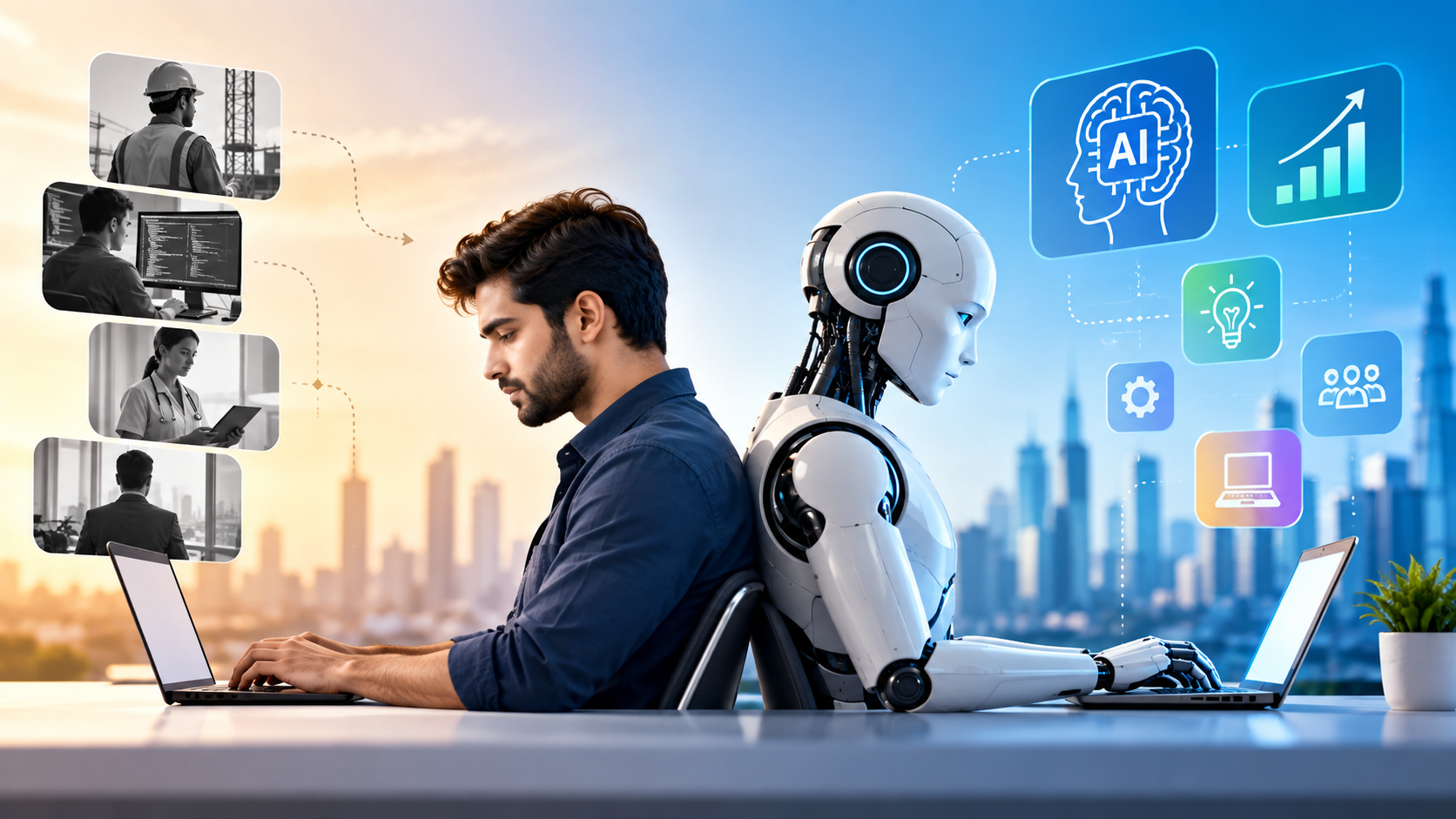
Three years ago, most people talked about AI as something coming. In 2026, it’s something here—quietly rewriting job descriptions, sitting inside your CRM, drafting your first-round interview questions, and, in some cases, doing the job a person used to do. The conversation has shifted from “will AI affect jobs?” to “how much, how fast, and what do I do about it?”
The honest answer is messier than the headlines suggest. AI isn’t simply destroying jobs or simply creating them—it’s doing both, unevenly, across industries, income levels, and skill sets. Understanding that nuance is the difference between panicking and preparing.
The Real Scale of AI’s Impact on Employment
Estimates vary widely depending on who’s measuring and how, but a few patterns show up consistently across recent labor market research:
- A large share of global employers expect AI to reshape their workforce needs before the end of the decade, with tens of millions of roles displaced worldwide.
- At the same time, a comparable or larger number of new roles are projected to emerge from AI adoption—many that didn’t exist five years ago.
- A meaningful share of U.S. work hours are now technically automatable with existing AI tools, even if companies haven’t rolled that automation out everywhere yet.
- Generative AI already touches a majority of daily work tasks across white-collar occupations, from writing and research to scheduling and basic analysis.
The takeaway isn’t “AI is taking over” or “AI is no big deal.” It’s that AI is functioning as a general-purpose technology—like electricity or the internet—that touches nearly every job, just not in the same way or at the same speed.
Which Jobs Are Most Affected by AI?
AI’s impact on employment isn’t random. It follows a fairly predictable logic: the more a job involves repetitive, rules-based, or pattern-recognition work, the more exposed it is to automation.
Jobs Facing the Most Disruption
- Data entry and administrative support – Scheduling, form processing, and basic data management are increasingly handled by AI agents.
- Customer service and call centers – Chatbots and voice AI now resolve a large share of routine customer queries.
- Basic content and copywriting – Templated product descriptions, summaries, and first-draft writing are widely AI-assisted or AI-generated.
- Bookkeeping and entry-level finance tasks – Reconciliation, invoicing, and basic reporting are prime automation targets.
- Manufacturing and warehouse roles – AI-powered robotics continue to absorb repetitive physical tasks, particularly in logistics and assembly.
Jobs More Resistant to Automation
- Roles requiring hands-on human care (nursing, therapy, skilled trades)
- Jobs built around complex judgment, negotiation, or trust (senior legal, executive leadership, sales strategy)
- Highly creative or original work that depends on lived experience and taste
- Roles requiring physical dexterity in unpredictable environments (plumbing, electrical work, on-site repair)
It’s worth noting that “AI-exposed” doesn’t always mean “AI-eliminated.” In many cases, AI removes parts of a job rather than the whole job—meaning the role survives, but the day-to-day work looks different.
New Careers AI Is Creating
For every job category under pressure, a new one is emerging around the technology itself. This is arguably the most underreported part of the AI employment story.
Roles Gaining Momentum in 2026
- AI prompt and workflow specialists – People who design, test, and refine how teams use AI tools inside real business processes
- AI ethics and governance roles – Positions focused on compliance, bias auditing, and responsible deployment
- AI trainers and data curators – Professionals who fine-tune models with domain-specific knowledge
- Human-AI collaboration managers – Roles that sit between technical teams and business units, translating AI capability into practical use
- AI-augmented specialists in existing fields – Doctors, lawyers, marketers, and engineers who use AI tools to work faster and take on more complex projects
Job platforms and hiring reports have flagged a consistent rise in postings that mention AI fluency as a requirement—not just for tech roles, but across marketing, HR, finance, and operations. AI literacy is quickly becoming a baseline expectation, similar to how basic spreadsheet skills became non-negotiable in the 2000s.
How AI Is Changing Workplace Productivity
Beyond job creation and displacement, AI is changing what a “productive day” even looks like.
Faster execution. Tasks that used to take hours—first drafts, data summaries, code scaffolding—now take minutes, freeing up time for higher-value work.
Flatter learning curves. New employees can lean on AI tools to get up to speed faster, reducing the traditional ramp-up period for many roles.
Always-on support. AI assistants handle scheduling, research, and routine communication around the clock, extending what a single employee can manage.
New friction points. Productivity gains aren’t automatic—teams report time lost to verifying AI output, retraining models on internal data, and managing tool sprawl across departments.
The businesses seeing the biggest productivity gains tend to share one trait: they’ve redesigned workflows around AI rather than simply bolting AI onto old processes.
Future Skills That Will Matter Most
As routine tasks get automated, the skills that hold value are shifting toward things AI still can’t reliably replicate.
Skills Worth Building Now
- AI fluency – Knowing how to prompt, evaluate, and correct AI output, even without a technical background
- Critical thinking and judgment – The ability to catch AI errors, biases, and blind spots
- Complex communication – Negotiation, persuasion, and relationship-building remain deeply human
- Adaptability – Comfort with frequent tool and process changes, rather than fixed routines
- Domain expertise – Deep knowledge in a specific field makes AI output more useful, not less necessary
- Emotional intelligence – Empathy-driven roles in healthcare, education, and management remain hard to automate
Employers increasingly value people who can direct AI tools effectively over people who simply avoid them.
How Employees and Businesses Can Adapt
For Employees
- Treat AI tools as part of your daily workflow, not a threat to avoid
- Identify which parts of your job are automatable and lean into the parts that aren’t
- Build a habit of continuous learning rather than one-time upskilling
- Document and communicate the judgment calls AI can’t make—that’s where your value lives
For Businesses
- Invest in reskilling programs before layoffs become the default response to automation
- Involve employees in AI rollout decisions to reduce resistance and improve adoption
- Focus AI investment on augmenting teams, not just cutting headcount
- Build clear governance around AI use, especially in customer-facing and compliance-sensitive areas
Companies that treat AI purely as a cost-cutting tool tend to see short-term savings and long-term talent problems. Companies that treat it as a capability multiplier tend to outperform over time.
The Bottom Line
AI isn’t a single event happening to the job market—it’s an ongoing negotiation between what machines can do, what humans do best, and how quickly organizations adapt. Some jobs will shrink. Others will grow. Most will simply change shape.
The people and businesses who come out ahead in 2026 and beyond won’t be the ones who ignore AI, or the ones who fear it. They’ll be the ones who learn to work alongside it—staying curious, staying adaptable, and staying focused on the distinctly human skills that no algorithm can fully replace.
Leave a Reply