
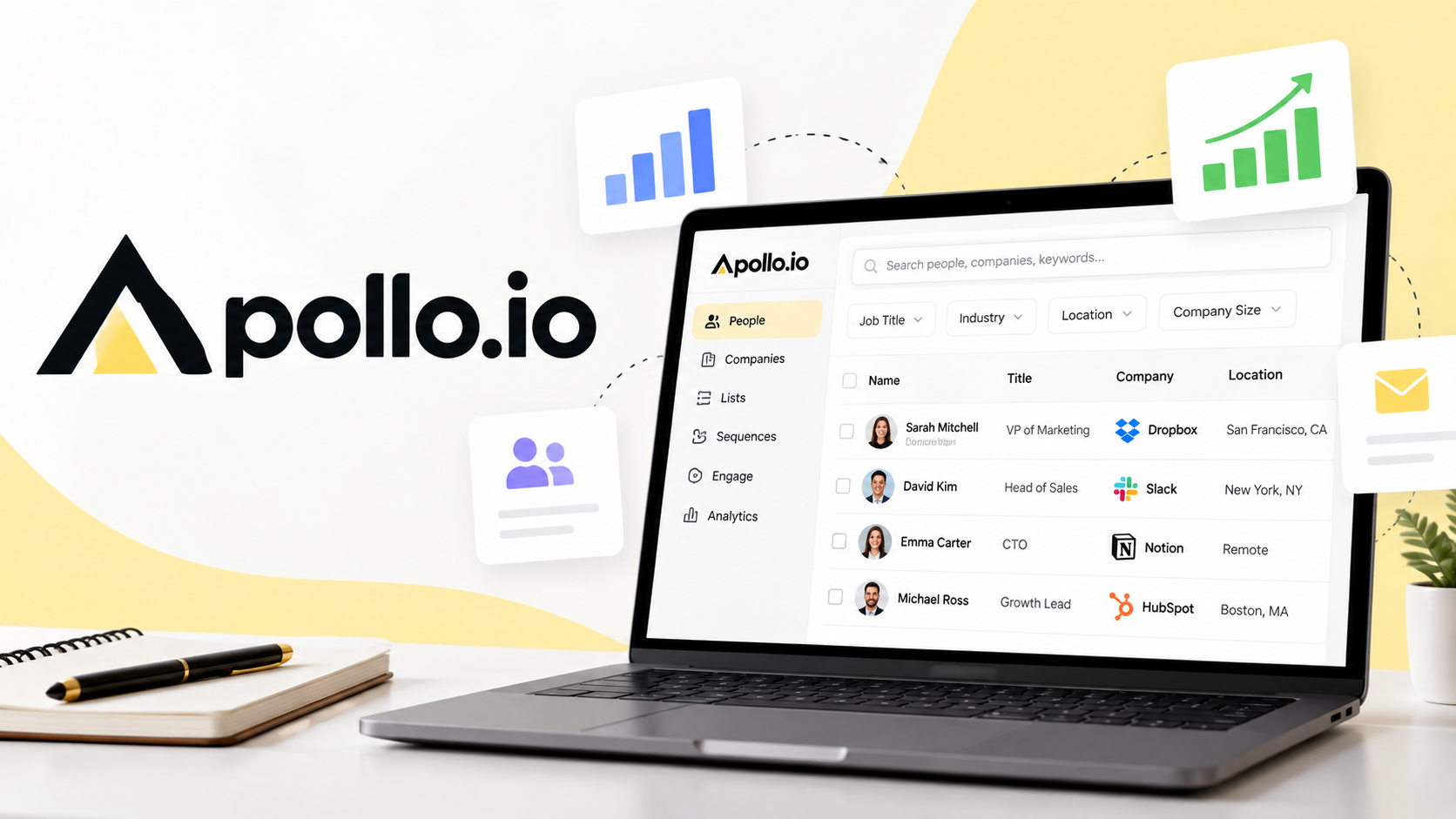
Finding the right prospects, getting their verified contact details, and then actually reaching them with a message they want to read — these are the three fundamental challenges of B2B sales. Apollo.io is one of the few platforms that tries to solve all three in a single workspace, combining a large B2B contact database with built-in sales engagement tools and AI-powered automation.
This guide covers how Apollo.io works, what its platform includes, who benefits from using it, and where the practical limitations lie — so you can assess whether it fits your sales workflow.
What Is Apollo.io?
Apollo.io is a sales intelligence and sales engagement platform that provides B2B teams with a combined prospecting database and outreach automation toolset. At its core, it gives users access to a large database of business contacts and company records, alongside tools to filter, export, and engage those contacts directly within the same platform.
Rather than maintaining separate subscriptions for a data provider (such as ZoomInfo or Lusha) and a sequencing tool (such as Reply.io or Outreach), Apollo.io consolidates both into a single product — which is its primary competitive positioning.
Key Features of the Apollo.io Platform
1. B2B Contact and Company Database
Apollo.io’s database is one of its most significant assets. It contains hundreds of millions of B2B contact records, including job titles, email addresses, phone numbers, company size, industry, technology usage, and more. Users can apply granular filters to narrow down a target list, including:
- Job title, seniority level, and department
- Company size (employee count and revenue range)
- Industry and sub-industry
- Geography (country, city, region)
- Technologies used (e.g., companies using Salesforce or HubSpot)
- Funding stage and investor data
- Hiring signals and job postings
This depth of filtering makes Apollo.io sales intelligence particularly valuable for building precise target lists without manual research.
2. Email Outreach and Sales Sequences
Apollo.io includes a full sales sequencing engine, allowing users to build automated, multi-step outreach campaigns. A typical sequence might include a cold email on day one, a follow-up on day four, a LinkedIn task on day seven, and a final email on day ten.
Each step can be personalized using dynamic variables — first name, company name, job title, recent news — and the platform supports A/B testing of subject lines and email body copy to identify which versions generate better response rates. This email outreach automation layer removes the manual work of tracking and sending follow-ups at scale.
3. AI-Powered Features
Apollo.io has invested significantly in AI capabilities across its platform. Key AI features include:
- AI email writing: Generates personalized first-line openers and full email drafts based on prospect data
- AI scoring: Rates contacts based on how closely they match your ideal customer profile (ICP), helping prioritize outreach effort
- Conversation intelligence: On higher-tier plans, records and analyzes sales calls, identifying talking points, objections, and next steps automatically
- Intent data signals: Surfaces companies showing behavioral signals that suggest they may be actively evaluating solutions in your category
4. LinkedIn Integration and Prospecting
Apollo.io offers a Chrome extension that works directly on LinkedIn, allowing users to find and enrich contact data while browsing profiles. This is useful for SDRs who prospect through LinkedIn and want to pull verified email addresses and phone numbers without leaving the platform.
Apollo sequences also support LinkedIn tasks — prompting reps to send a connection request or message at a defined step in the workflow — making it a multichannel outreach tool rather than email-only.
5. CRM Integration and Data Sync
Apollo.io integrates natively with Salesforce, HubSpot, and other major CRMs, as well as through Zapier for broader workflow connectivity. Contacts discovered and engaged in Apollo can be automatically synced to your CRM, and existing CRM records can be enriched with Apollo’s data — filling in missing phone numbers, job titles, or company details.
This sales workflow integration reduces double data entry and keeps your CRM accurate as contacts change roles or companies.
6. Analytics and Reporting
The platform provides sequence-level and team-level analytics including open rates, reply rates, bounce rates, and meeting booked rates. Managers can view performance breakdowns by individual rep, sequence, or email step — making it easier to identify what is working and where specific campaigns or team members need adjustment.
Who Can Use Apollo.io?
Sales Development Representatives (SDRs)
Apollo.io is built around the SDR workflow. The combination of prospecting, list building, sequencing, and task management in one interface means SDRs can start their day in Apollo and complete most of their outbound activities without switching between tools.
B2B Startups and Scale-ups
Early-stage companies that need to build pipeline quickly but cannot afford separate data and engagement tools benefit from Apollo’s consolidated offering. The free plan and accessible paid tiers make it viable for teams with limited budgets who still need access to quality prospect data.
Marketing Agencies and Lead Generation Businesses
Agencies running outreach campaigns on behalf of clients can use Apollo’s filtering capabilities to build targeted lists for specific industries, geographies, or company profiles. The sequencing tools then allow those lists to be engaged at scale with consistent, trackable campaigns.
Account Executives and Revenue Teams
Beyond pure outbound prospecting, AEs use Apollo to research accounts, identify additional stakeholders within target companies, and prepare for discovery calls using the platform’s enriched company and contact intelligence.
Practical Benefits
- Fewer tools, lower cost: Replacing separate data and engagement subscriptions with Apollo can reduce overall sales stack spend
- Faster list building: Advanced filters allow precise ICP targeting in minutes rather than hours of manual research
- Higher contact rates: Multi-touch sequences across email and LinkedIn increase the likelihood of a response
- Cleaner CRM data: Automatic enrichment keeps contact records current as people change roles
- Better prioritization: AI scoring helps teams focus effort on the most likely-to-convert prospects first
Limitations and Important Considerations
- Data accuracy varies: While Apollo’s database is extensive, contact data — especially direct phone numbers and personal emails — can become outdated quickly in markets with high job mobility. Always validate critical contacts before high-stakes outreach
- Email deliverability requires setup: Like any cold email platform, users must properly configure sending domains with SPF, DKIM, and DMARC records and warm up email accounts before sending at volume
- Export and usage limits: Contact exports and email credits are capped based on your plan tier, which can limit volume for heavy users on lower-tier plans
- Depth vs. dedicated tools: Teams with very high-volume, complex sequencing needs may find that dedicated engagement platforms like Outreach or Salesloft offer more granular workflow controls
- Learning curve: The breadth of Apollo’s features means new users often need several weeks to use the platform to its full potential
Apollo.io vs. Key Alternatives
| Platform | Primary Strength | Best For |
|---|---|---|
| Apollo.io | Combined database + sequencing platform | SMB and mid-market B2B teams wanting an all-in-one tool |
| ZoomInfo | Enterprise-grade data depth and accuracy | Large enterprises with dedicated data teams |
| Lusha | Lightweight contact enrichment | Individual reps needing quick contact lookup |
| Reply.io | Advanced multichannel engagement automation | Teams that already have a data source and need outreach depth |
| Outreach.io | Enterprise sales workflow management | Large revenue organizations with complex sequencing needs |
Apollo.io’s strongest value proposition is for teams in the SMB and mid-market space who want a capable, consolidated platform without the enterprise pricing of ZoomInfo or Outreach.
Getting the Most Out of Apollo.io
Teams that see the best results from Apollo.io typically share a few common practices. They invest time upfront in defining their ideal customer profile precisely, which makes Apollo’s filtering genuinely powerful rather than producing generic lists. They also set up email deliverability infrastructure correctly from the start — including separate sending domains, warm-up routines, and daily sending limits — which protects both deliverability and sender reputation over time.
Using Apollo’s intent data and AI scoring to prioritize which contacts to engage first — rather than blasting every record in a list — tends to produce meaningfully better response rates and conserves credit limits more efficiently.
Conclusion
Apollo.io addresses a real and persistent challenge in B2B sales: the need to find verified prospect data and then engage those prospects efficiently, without stitching together multiple tools. For sales teams, startups, and agencies operating in the SMB to mid-market space, it delivers a practical and cost-effective combination of B2B lead generation, data enrichment, and outreach automation in a single workspace.
Its limitations — variable data accuracy, credit caps, and a learning curve — are worth understanding before committing. But for teams that take the time to set it up correctly and use it consistently, Apollo.io can become a durable, central component of an effective outbound sales operation.
Frequently Asked Questions (FAQs)
1. Is Apollo.io free to use?
Apollo.io offers a free plan with limited credits for contact exports and email sending. Paid plans unlock higher limits, more advanced features, and additional AI capabilities. The free plan is useful for evaluating the platform but is typically insufficient for sustained outbound campaigns.
2. How accurate is Apollo.io’s contact data?
Apollo.io’s database is extensive, but data accuracy varies. Business email addresses are generally reliable, while direct phone numbers and personal contact information can be less consistent. It is best practice to verify high-priority contacts independently before important outreach.
3. Can Apollo.io replace a standalone CRM?
No. Apollo.io is a sales intelligence and engagement platform, not a CRM. It is designed to work alongside CRMs like Salesforce and HubSpot, syncing contact and activity data into those systems. It does not replace CRM functionality for pipeline management, deal tracking, or customer relationship history.
4. Does Apollo.io work for outbound email campaigns?
Yes. Apollo.io includes a full sequencing engine for automated outbound email campaigns, including follow-up steps, A/B testing, and deliverability monitoring. Users must set up their sending infrastructure correctly for best results.
5. Who are Apollo.io’s main competitors?
Apollo.io’s primary competitors include ZoomInfo (enterprise data), Lusha (contact enrichment), Reply.io (sales engagement), Outreach.io (enterprise engagement), and LinkedIn Sales Navigator (social prospecting). The right alternative depends on whether your primary need is data, engagement automation, or both.
Leave a Reply