
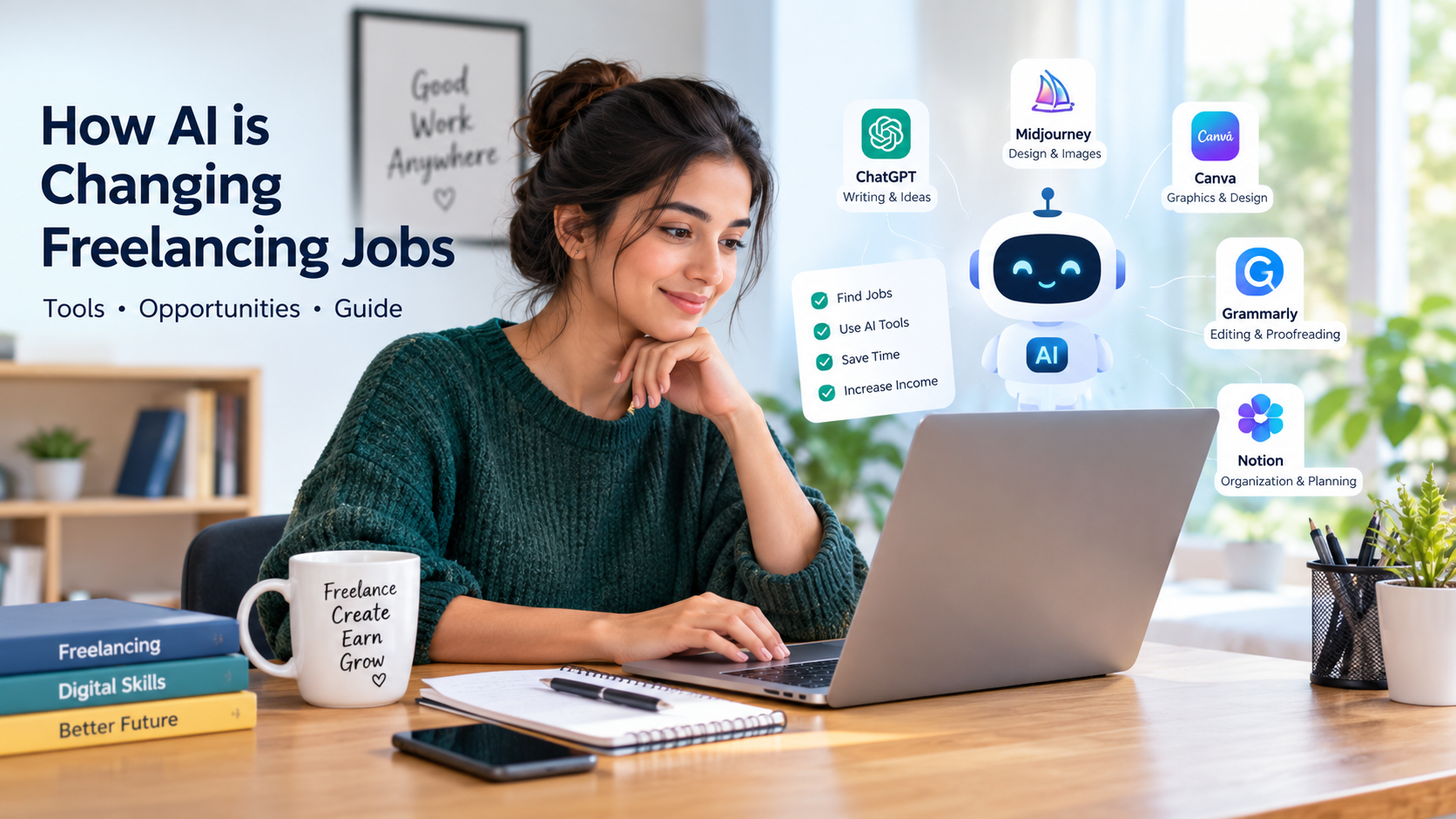
For decades, the freelance economy operated on a simple exchange: clients lacked the time or skill to complete a specific task, so they hired an independent professional to do it. But in 2026, the definition of what a computer can do automatically has expanded at a staggering pace. Generative artificial intelligence is now capable of writing functional code, drafting marketing copy, generating high-quality illustrations, and editing video—often in seconds, and often for pennies.
This technological shift has caused understandable anxiety across the gig economy. Many freelancers have experienced a sudden drop in demand for baseline, entry-level tasks. But a closer look reveals that AI is not destroying the freelance economy; it is fundamentally restructuring it. The freelancers who are currently succeeding are not competing with algorithms—they are using them to evolve their service offerings.
To understand where the opportunities lie today, we have to look at the changing journey of a modern freelancer, from the tasks that are disappearing to the high-value skills that clients are now desperate to buy.
Phase 1: Recognizing the Shift (What is Actually Changing?)
The first step in adapting to the AI era is acknowledging which parts of the traditional freelance workflow have been permanently altered. AI has effectively raised the floor of what is considered acceptable work, heavily impacting professionals who previously relied on high-volume, low-complexity tasks.
The Impact on Writing and Content Creation
In the past, a freelance writer could build a sustainable business simply by churning out generic, SEO-optimized blog posts. Today, Large Language Models (LLMs) can produce that level of content instantly. However, AI still struggles with genuine thought leadership, primary research, interviewing subject matter experts, and crafting a unique brand voice. The demand has shifted from “content generation” to “content strategy and editing.”
The Impact on Design and Video
Graphic designers are seeing AI image generators handle basic illustration, stock photography replacement, and rapid concept generation. Video editors face tools that can automatically cut silence, generate B-roll, and clean up audio. Yet, AI cannot ensure visual consistency across a complex brand identity or tell a compelling, emotionally resonant visual story. Designers are pivoting from being pixel-pushers to becoming art directors.
The Impact on Coding and Development
Freelance developers are utilizing AI coding assistants to write boilerplate code, debug scripts, and suggest optimizations. While this allows junior developers to work faster, it also means clients expect faster turnaround times for basic web builds. The premium is now placed on complex system architecture, security, and integrating AI application programming interfaces (APIs) into client products.
The Impact on Virtual Assistance and Marketing
Administrative tasks like data entry, basic email sorting, and scheduling are increasingly handled by automated AI agents. Marketers are finding that AI can generate dozens of ad variations in seconds. The human value is now in data analysis, audience psychology, and managing the AI systems themselves.

Phase 2: The Transition from Maker to Manager
As the “doing” of the work becomes automated, successful freelancers are transitioning their mindset from being “makers” to becoming “managers and strategists.”
When a client hires a freelancer in 2026, they are rarely paying just for the raw output. If a client simply wanted raw output, they could prompt an AI themselves. Instead, they are paying for curation, taste, and quality assurance. A client might use AI to write an initial draft, but they hire an expert freelance writer to inject industry nuance, ensure factual accuracy, and verify that the tone aligns with their brand.
This transition deeply impacts how freelancers price their services. Hourly billing is becoming increasingly risky. If you charge by the hour, and an AI tool allows you to finish a project in one hour instead of five, your income collapses. Freelancers are rapidly moving toward value-based pricing or project-based flat fees. You are no longer charging for the hours it takes to complete the task; you are charging for your expertise, your specialized workflow, and the final business result you deliver to the client.
Phase 3: Building the 2026 AI Toolkit
Adapting does not mean a freelancer needs to become a machine learning engineer. It means thoughtfully integrating AI tools into daily operations to increase productivity and profit margins.
A modern freelance toolkit typically involves several layers. First are the generative assistants—tools like ChatGPT, Claude, or specialized industry alternatives—used for brainstorming, outlining, and overcoming the blank page. Second are the domain-specific AI tools, such as AI-powered design software that handles background removal and layout generation, or coding environments that auto-complete complex functions.
Equally important are data analysis and research AIs. Freelance marketers and strategists use specialized AI to digest massive market reports, summarize competitor websites, and extract key data points in minutes. The ability to synthesize vast amounts of information quickly gives an independent freelancer the research power that previously required an entire agency team.
Finally, there are automation workflows. Smart freelancers connect different apps together so that when a client signs a contract, an AI automatically generates an onboarding email, sets up a project management board, and schedules a kickoff meeting. The goal is to use AI to handle the administrative friction of freelancing, reserving maximum human energy for the actual client work.
Phase 4: Discovering New Service Opportunities
The narrative that AI only takes jobs ignores the massive wave of new freelance roles it has created. Businesses know they need to adopt AI to stay competitive, but most lack the internal expertise to do so safely and effectively. This has birthed entirely new freelance categories.
AI Workflow Integrators are highly sought after. These are freelancers who analyze a client’s business, identify bottlenecks, and implement AI tools to solve them. AI Content Editors specialize in taking AI-generated drafts and polishing them to bypass AI detectors and meet human editorial standards.
Furthermore, there is a booming market for Prompt Engineers and AI consultants who can teach a company’s staff how to use these tools effectively. If you can master an AI tool relevant to your industry, you can sell that mastery as a service.
The Final Stage: Retaining the Human Premium
If you look at the freelance journey through the lens of AI, the ultimate destination is a realization about what clients actually value. AI is exceptional at generating text, predicting code, and manipulating pixels. But it is fundamentally incapable of empathy, relationship building, and genuine strategic partnership.
The “Human Premium” is the extra value a client is willing to pay for peace of mind. A client hires a human freelancer because they want someone to look them in the eye on a Zoom call, understand their unstated business anxieties, and tell them, “I understand the problem, and I will take care of it.”
Furthermore, human freelancers possess lived experience. A travel writer brings the physical memory of a destination; a UX designer brings the frustration of having navigated a poorly designed app. AI operates solely on statistical probability derived from its training data. It has never experienced the physical world. Injecting your lived experience, your personal perspective, and your unique worldview into your work is the ultimate differentiator that no algorithm can replicate.
To survive and thrive in this new era, freelancers must aggressively automate the mechanical parts of their job while doubling down on the human elements. Deepen your industry expertise, improve your client communication, and cultivate a reputation for reliability. AI can do the work, but it cannot replace the trust a client places in a professional.
Frequently Asked Questions (FAQs)
1. Will AI eventually replace freelance writers and designers completely?
No, but it will replace writers and designers who refuse to adapt. AI excels at generic, baseline production, meaning demand for low-tier, repetitive work is shrinking. However, the demand for high-level strategy, editing, original research, and creative direction remains strong, as AI cannot replicate human nuance, cultural context, or deep strategic thinking.
2. How should I change my freelance pricing because of AI?
Because AI dramatically speeds up production time, charging an hourly rate will likely reduce your income. Most modern freelancers are shifting to value-based pricing or flat project fees. You should charge based on the value and outcome you deliver to the client, regardless of whether an AI tool helped you finish the project in half the time.
3. What are the best AI skills for a freelancer to learn in 2026?
Beyond mastering generative tools (like advanced prompt engineering for text and image models), the most valuable skills involve workflow automation. Learning how to connect AI APIs to standard business software (like CRMs or project management tools) allows you to offer highly valuable operational upgrades to your clients.
4. Do clients care if I use AI to complete their freelance projects?
Client attitudes vary widely. Some demand that you use AI to increase output and lower costs, while others strictly prohibit it due to copyright or confidentiality concerns. The best practice is complete transparency. Discuss AI usage during the negotiation phase, clarify how you will protect their proprietary data, and outline how AI fits into your overall workflow.
5. Is it safe to put my client’s confidential information into an AI tool?
It is generally unsafe to enter sensitive, proprietary, or confidential client data into public, free AI tools, as that data may be used to train future models. If you plan to use AI for client work involving sensitive data, you must use enterprise-grade tools with strict data privacy agreements that guarantee your inputs will not be retained or used for training.
Leave a Reply