
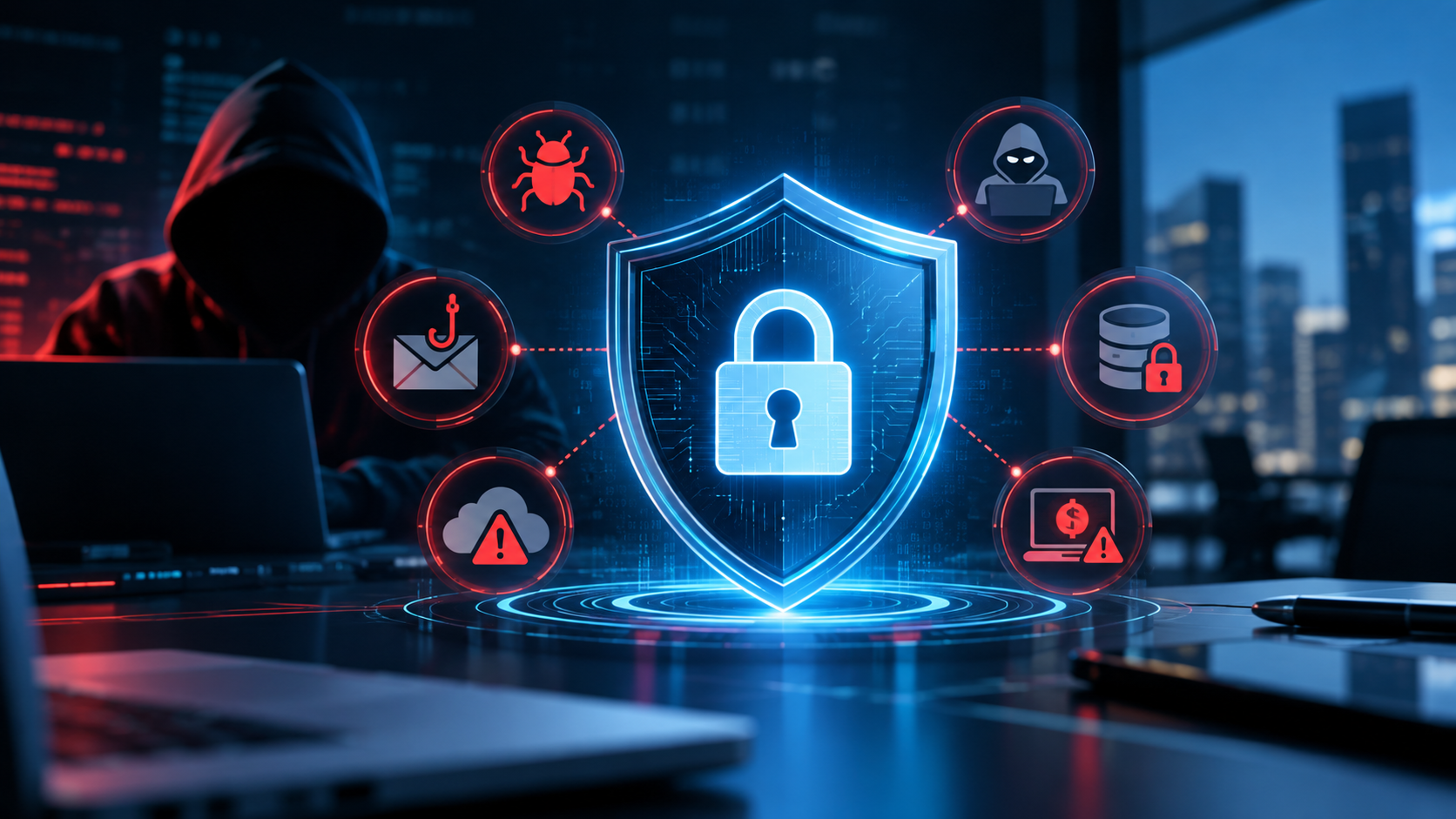
Cyberattacks used to be a once-in-a-while headline. Now they’re a daily operational risk. Ransomware gangs run their operations like software companies, phishing emails are written by AI that never misspells a word, and a single leaked password can unravel an entire network. For business owners and IT teams alike, the question isn’t if an attack will be attempted — it’s whether your defenses are ready when it happens.
This guide breaks down the threats shaping the current cybersecurity landscape and, more importantly, what businesses can actually do about each one.
1. Ransomware Is Still the Big One
Ransomware hasn’t slowed down — it’s evolved into a full-blown criminal industry. Attackers now use “double extortion,” encrypting your files and threatening to leak stolen data if you don’t pay. Ransomware-as-a-Service (RaaS) kits let even low-skill criminals launch sophisticated attacks for a cut of the profits.
Small and mid-sized businesses are increasingly the preferred targets, not because the payouts are bigger, but because their defenses are weaker.
How to defend against it:
- Keep offline, tested backups so you can recover without paying
- Patch software and operating systems on a strict schedule
- Segment your network so one infected device can’t take down everything
- Build (and rehearse) an incident response plan before you need one
2. Phishing and Social Engineering Keep Getting Sharper
Phishing remains the single most common way attackers get their foot in the door. But it doesn’t look like the obvious scam emails of a decade ago anymore. Messages now arrive personalized, well-written, and perfectly timed — often referencing real vendors, invoices, or internal projects.
Attackers have also expanded beyond email into SMS (“smishing”), fake login portals, and phone calls that mimic real IT support (“vishing”).
Practical defenses:
- Run regular, realistic phishing simulations for employees
- Enforce multi-factor authentication (MFA) everywhere possible
- Train staff to verify unusual payment or credential requests through a second channel
- Use email filtering tools that flag spoofed domains and suspicious links
3. AI-Powered Attacks Are Changing the Rules
Artificial intelligence isn’t just helping defenders anymore — attackers are using it too. AI tools can write flawless phishing emails in seconds, scan for vulnerable systems automatically, and even generate deepfake audio or video to impersonate executives.
Voice-cloning scams, where a fraudster mimics a CEO’s voice to request an urgent wire transfer, are becoming disturbingly convincing. This blurs the line between “obviously fake” and “hard to tell,” which is exactly why traditional awareness training needs an update.
What helps:
- Establish verification protocols for any financial request, regardless of how it’s delivered
- Invest in AI-driven threat detection tools that can spot anomalies faster than humans
- Educate leadership specifically on deepfake and voice-cloning risks
- Treat urgency and pressure in a message as a red flag, not a reason to act fast
4. Data Breaches: The Cost Keeps Climbing
A single data breach can cost millions once you factor in downtime, legal exposure, regulatory fines, and reputational damage. Breaches increasingly start with something mundane — a misconfigured cloud bucket, a reused password, or an unpatched third-party tool.
Reducing your exposure:
- Encrypt sensitive data both at rest and in transit
- Apply the principle of least privilege — employees should only access what they need
- Regularly audit where sensitive data lives and who can reach it
- Have a breach notification plan ready so you can respond quickly and transparently
5. Insider Threats Are Often Overlooked
Not every threat comes from outside the organization. Insider threats — whether malicious, negligent, or simply careless — account for a significant share of security incidents. A disgruntled employee, a contractor with excessive access, or someone who accidentally emails sensitive data to the wrong address can all cause real damage.
Managing the risk:
- Monitor for unusual access patterns without creating a culture of surveillance overkill
- Revoke access immediately when employees or contractors leave
- Limit administrative privileges to those who truly need them
- Build a workplace culture where people report mistakes early instead of hiding them
6. Cloud Security Gaps
As more businesses move workloads to the cloud, misconfiguration has become one of the leading causes of exposure. Open storage buckets, weak access controls, and forgotten test environments are common entry points for attackers.
Cloud security essentials:
- Use cloud security posture management (CSPM) tools to catch misconfigurations automatically
- Apply MFA and strong identity controls to every cloud account
- Regularly review third-party app permissions connected to your cloud environment
- Don’t assume your cloud provider handles all security — most operate on a shared responsibility model
7. IoT Devices Widen the Attack Surface
Smart cameras, connected printers, badge readers, and other IoT devices often ship with weak default security — and they’re rarely updated once installed. Each connected device is a potential entry point into your network.
Steps to reduce IoT risk:
- Change default credentials on every device immediately
- Keep IoT devices on a separate network segment from core business systems
- Maintain an inventory of every connected device on your network
- Apply firmware updates as soon as they’re released
8. Identity-Based Attacks Are on the Rise
Stolen or compromised credentials remain one of the top ways attackers break into systems. Credential-stuffing attacks, where hackers use leaked username-password combinations from one breach to try their luck elsewhere, are alarmingly effective because so many people reuse passwords.
Strengthening identity security:
- Require MFA across all critical systems, not just email
- Use a password manager to eliminate password reuse
- Monitor for compromised credentials appearing in known data leaks
- Consider passwordless authentication methods where feasible
9. Emerging Risks to Watch
Beyond the established threats, a few emerging risks deserve attention:
- Supply chain attacks — compromising a trusted vendor to reach their customers
- Zero-day exploits — attacks on vulnerabilities before a patch even exists
- API vulnerabilities — as businesses connect more systems together, poorly secured APIs become new targets
- Shadow AI usage — employees using unapproved AI tools with sensitive company data
Staying ahead of these means treating cybersecurity as an ongoing process, not a one-time project.
Building a Culture of Cyber Resilience
No single tool or policy can eliminate cyber risk entirely. The businesses that hold up best under attack are the ones that combine:
- Layered technical defenses (firewalls, endpoint protection, encryption)
- Regular employee training that evolves with new attack tactics
- Clear incident response plans that are actually tested, not just written
- Leadership buy-in that treats security as a business priority, not just an IT line item
Final Thoughts
The cybersecurity threats businesses face today are more varied, more convincing, and more automated than ever before. But the fundamentals of good defense — strong access controls, regular training, tested backups, and a culture of vigilance — remain just as effective as ever.
Treat cybersecurity not as a checkbox, but as an ongoing habit woven into how your business operates. The organizations that do this consistently are the ones that recover quickly when — not if — something goes wrong.
Leave a Reply