
For more than a decade, Apple resisted touchscreens on laptops. Steve Jobs famously stated in 2010 that vertical touchscreens were ergonomically flawed, arguing that extended reaching caused arm fatigue. At its late-October “Pro and Tell” event, Apple officially overturned that policy by unveiling its first-ever MacBook touchscreen hardware. The announcement marks a transformative milestone, bringing direct multi-touch capability to macOS alongside a tandem OLED display and Apple Silicon performance gains.
The debut was headlined by the touchscreen MacBook Pro with PROLED XDR Display, accompanied by an updated 14-inch MacBook Pro powered by the next-generation Apple MacBook M6 chip. Financial media including CNBC and technology analysts noted that Apple is now directly challenging high-end Windows workstations. As covered across Apple MacBook latest news, this guide breaks down confirmed new MacBook Pro features, display capabilities, touch ergonomics, pricing, and key differences across the lineup.
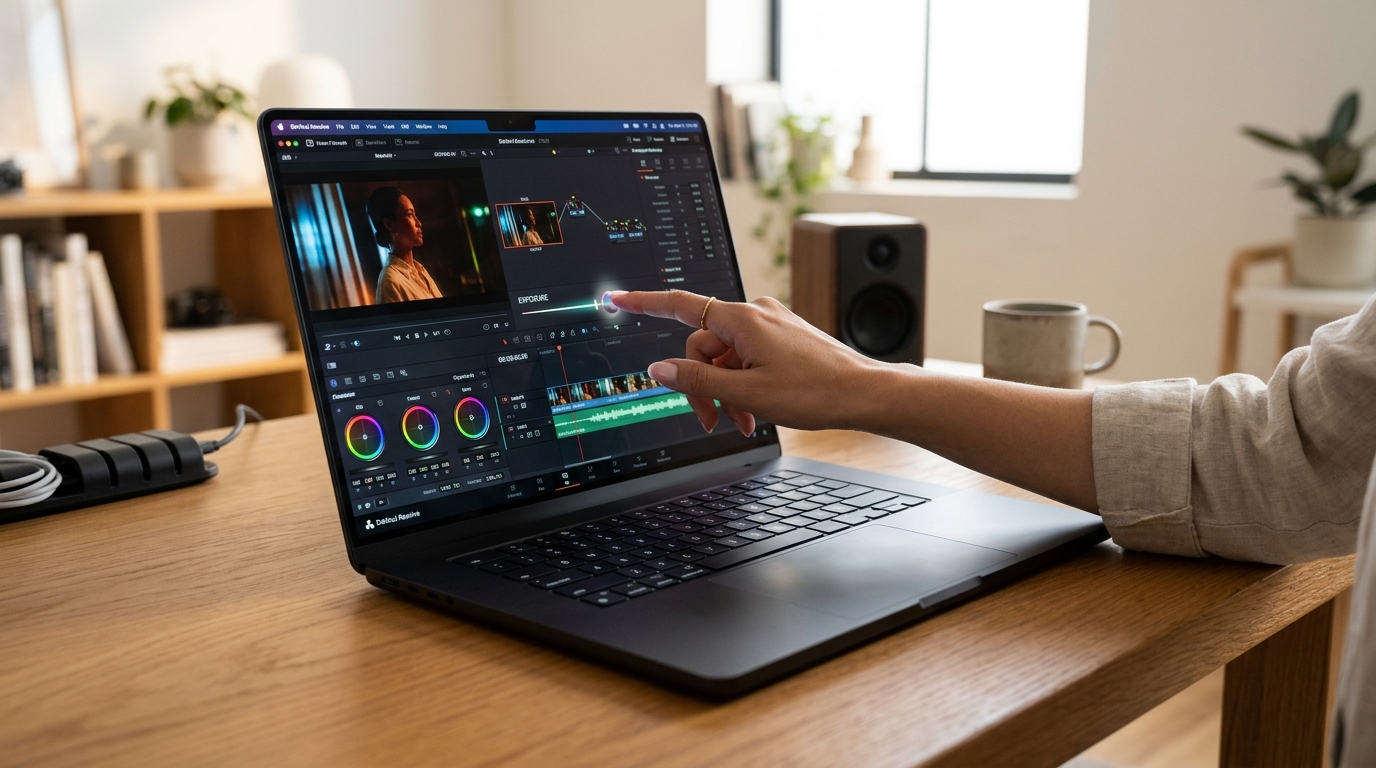
The Evolution of Touch on Mac: Why Apple Finally Embraced the Screen
To understand the significance of the Apple touchscreen MacBook, one must consider how Mac hardware has evolved. In 2016, Apple introduced the Touch Bar to provide contextual shortcuts without touching the display. While innovative, developer feedback was mixed, and Apple eventually returned to mechanical function keys.
Meanwhile, the convergence of iPadOS and macOS workflows generated sustained demand for direct screen interaction. Creative professionals routinely move between iPads and Macs, making touch an intuitive expectation. Similar to hardware advancements explored in our review of the iPhone Duo price and features, Apple waited until engineering met its strict standards. According to the Apple Newsroom, a dual-layer tandem OLED panel and a custom friction-damped hinge enabled this MacBook touchscreen capability without compromising durability.
MacBook Touchscreen Models: Confirmed Specifications and PROLED XDR Display
The centerpiece of Apple’s touch lineup is the MacBook Pro with PROLED XDR Display, offered in 14-inch and 16-inch sizes. Rather than adding a basic touch film, Apple engineered a custom panel architecture called PROLED XDR.
The upgraded MacBook Pro display uses tandem OLED technology, stacking two emissive layers for extreme brightness and color precision. Crucial MacBook Pro specifications include a 10,000,000:1 contrast ratio, up to 2,000 nits peak HDR brightness, 1,000 nits sustained full-screen brightness, and ProMotion 120Hz adaptive refresh rates. The display also introduces the Dynamic Island to the Mac, housing a 12MP Center Stage camera while displaying Live Activities and render progress. Driven by Apple’s M5 Pro and M5 Max chips, these models support up to 128GB of unified memory.
How Touch Interaction Works in macOS: Gestures, Ergonomics, and Hinge Stability
A primary concern regarding any Apple touchscreen laptop has been interface usability. Desktop operating systems designed for precision pointers often feature small targets that frustrate finger navigation. Apple addressed this challenge through intelligent adaptive software in macOS.
In hands-on impressions published by The Verge, reviewers highlighted that macOS introduces dynamic proximity scaling. As a user’s hand approaches the display, window controls and menus subtly enlarge, ensuring accurate touch input. On macOS, touch serves as an additive shortcut for scrubbing video timelines in Final Cut Pro, rotating 3D viewports in Blender, and swiping documents. A friction-damped hinge holds the screen securely in place when tapped. Notably, the MacBook touchscreen relies strictly on finger gestures, as Apple omitted Apple Pencil support to preserve the iPad Pro as its dedicated drawing canvas.
The New 14-Inch MacBook Pro with M6: Speed, AI, and Extended Battery Life
Alongside the touch flagship, Apple updated its mainstream professional tier with the standard 14-inch MacBook Pro powered by the new Apple MacBook M6 chip. Crucially, this entry model does not include a MacBook touchscreen, serving as a value-focused powerhouse for users who prefer traditional mouse and keyboard workflows.
The standard M6 MacBook Pro retains Apple’s classic Liquid Retina XDR display (mini-LED) and emphasizes architectural efficiency. It features a 12-core CPU, a 12-core GPU delivering a twenty-five percent speed increase, and a Dual 16-core Neural Engine tailored for on-device Apple Intelligence. As discussed in our analysis of emerging technologies reshaping enterprise computing, localized AI acceleration has become essential for modern laptops. It delivers up to 24 hours of battery life alongside Wi-Fi 7 and Thunderbolt 5 ports.
Addressing the Rumors: What Happened to the MacBook Studio?
Leading up to Apple’s launch event, industry leaks predicted a standalone 2-in-1 device branded as the “MacBook Studio,” featuring a 360-degree rotating hinge or a detachable screen. However, official announcements revealed that Apple rejected convertible hinges. Instead, Apple integrated multi-touch directly into the established MacBook Pro chassis, preserving structural rigidity, thermal dissipation, and the refined unibody that professionals expect.
MacBook Touchscreen vs. Windows Laptops and Traditional MacBooks
The introduction of a touchscreen MacBook Pro reshapes competition across high-end laptops. For years, Windows manufacturers like Dell (XPS), Microsoft (Surface Laptop), and Lenovo (ThinkPad) marketed touchscreens as an exclusive advantage over Apple hardware.
Compared to Windows touch laptops, Apple’s implementation avoids loose hinges or disjointed tablet modes. Because macOS remains centered on keyboard-and-trackpad precision, touch acts as a seamless accelerator rather than an awkward replacement. Additionally, the tandem OLED MacBook Pro display offers superior contrast over matte touch coatings used on competing notebooks. Against traditional non-touch MacBooks, the primary trade-offs are price and fingerprint maintenance. For media professionals working in workflows highlighted in our guide to NAB Show tools for content creators, tactile timeline control far outweighs routine cleaning.
MacBook Pro Price, Configurations, and Release Timeline
Buyers should understand the clear price separation between the standard non-touch M6 model and the premium touchscreen PROLED XDR configurations. The official MacBook Pro price structure in the United States is outlined below:
- 14-inch MacBook Pro (M6, Non-Touch): Starts at ,599 with 16GB memory and 512GB SSD storage.
- 14-inch MacBook Pro (M5 Pro, Touchscreen PROLED XDR): Starts at ,899 with 24GB memory and 1TB SSD storage.
- 16-inch MacBook Pro (M5 Pro, Touchscreen PROLED XDR): Starts at ,399 with 36GB memory and 1TB SSD storage.
- 14-inch MacBook Pro (M5 Max, Touchscreen PROLED XDR): Starts at ,499 with 48GB memory and 2TB SSD storage.
- 16-inch MacBook Pro (M5 Max, Touchscreen PROLED XDR): Starts at ,799 with 64GB memory and 2TB SSD storage.
Regarding the MacBook touchscreen release date, Apple opened pre-orders immediately following the announcement, with retail store delivery and official shipments beginning on Friday, November 6, 2026.
Weighing Key Strengths and Limitations
Prospective buyers should evaluate the device’s key advantages alongside practical trade-offs.
Core Strengths
- OLED Quality: Tandem OLED delivers 2,000 nits peak brightness and true deep blacks.
- Direct Manipulation: Timeline scrubbing, audio adjustments, and 3D rotations feel immediate.
- Solid Hinge: Tuned friction damping eliminates screen wobble during active tapping.
- Balanced Lineup: Mainstream users can choose the non-touch M6, while power users can invest in PROLED touch flagships.
Practical Limitations
- High Price: A ,899 starting point positions the touchscreen model strictly within the premium tier.
- No Stylus Input: Digital artists cannot use the Apple Pencil directly on the screen.
- Fingerprint Smudges: Glossy OLED glass requires regular wiping to clear fingerprints.
Frequently Asked Questions
Does the new MacBook Pro have a touchscreen?
Yes, Apple introduced its first touch-enabled laptop with the MacBook Pro with PROLED XDR Display, available in 14-inch and 16-inch sizes. However, the standard 14-inch MacBook Pro powered by the M6 chip remains non-touch.
Which MacBook models support touchscreen interaction?
Touchscreen support is exclusive to the high-end MacBook Pro with PROLED XDR Display models powered by M5 Pro and M5 Max chips. The standard M6 14-inch model, MacBook Air models, and older generations do not feature touch displays.
Can you use the Apple Pencil on the touchscreen MacBook Pro?
No, the touchscreen MacBook Pro supports finger multi-touch gestures exclusively. Apple intentionally omitted Apple Pencil compatibility to maintain the iPad Pro as its dedicated digital drawing canvas.
What is the difference between the M6 MacBook Pro and the PROLED XDR model?
The 14-inch M6 MacBook Pro is an entry professional laptop featuring a non-touch mini-LED screen, up to 24 hours of battery life, and a ,599 starting price. The PROLED XDR model is an ultra-premium workstation featuring a tandem OLED touchscreen, Dynamic Island, M5 Pro or M5 Max chips, and a ,899 starting price.
When is the MacBook touchscreen release date?
Pre-orders for the MacBook touchscreen models opened in late October following Apple’s keynote, with official customer deliveries and retail store availability beginning on November 6, 2026.
Conclusion
The debut of the MacBook touchscreen marks a historic turning point for Apple and the broader laptop industry. By blending multi-touch versatility with the visual quality of a tandem OLED PROLED XDR display, Apple has erased a decade-long divide between touch ergonomics and desktop performance. While the ,899 entry price makes the touch-enabled flagship a specialized creative investment, the accompanying M6 refresh guarantees exceptional efficiency for developers and everyday professionals. As macOS continues to adapt to direct-manipulation gestures, Apple’s latest hardware lineup sets an extraordinary benchmark for the future of mobile computing.
Leave a Reply