
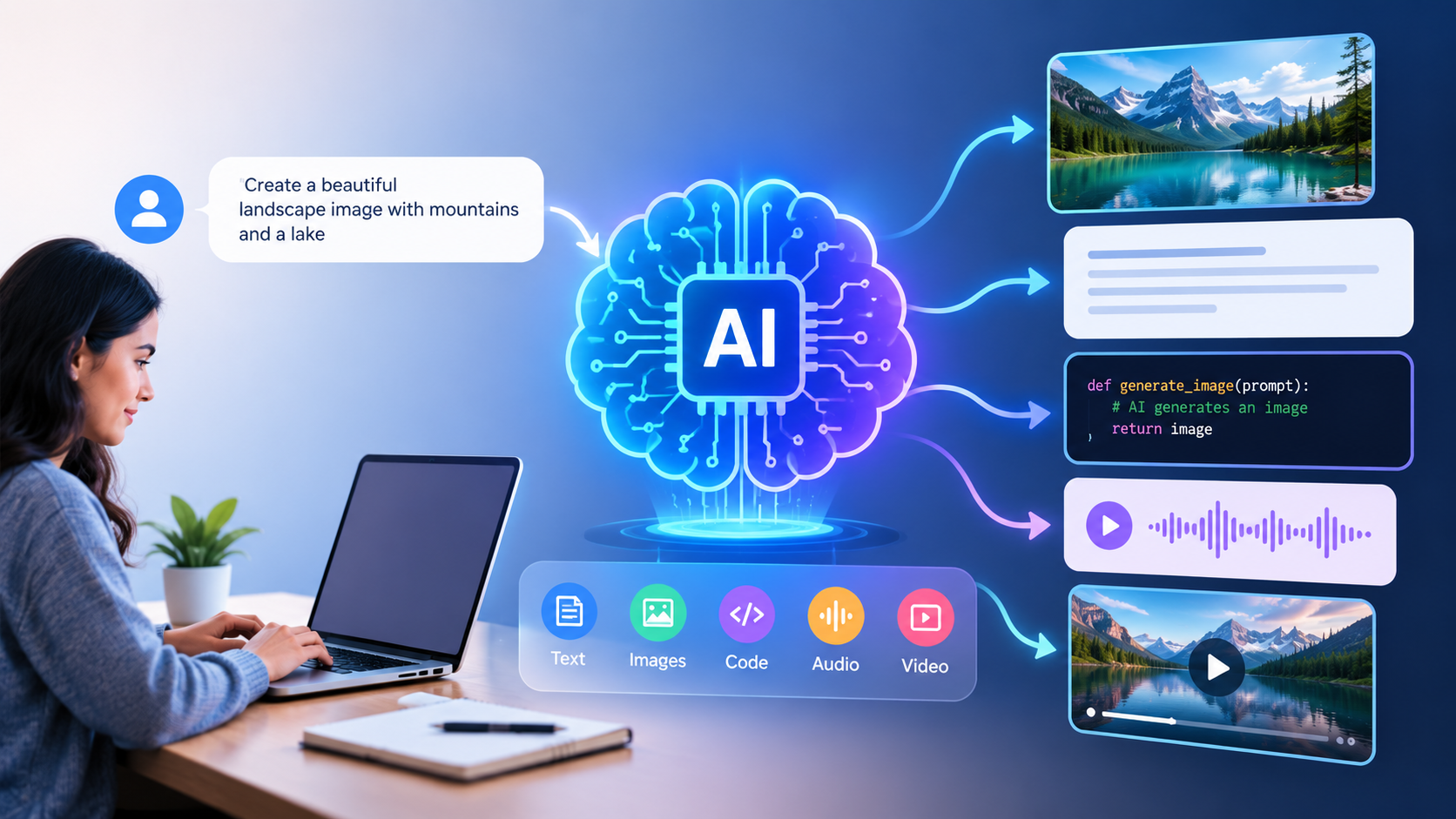
You sit in front of a blank screen, type a sentence into a text box, and press enter. Within seconds, a fully formed essay, a photorealistic image, or a functional block of computer code appears before your eyes. It feels like magic, or perhaps like a highly advanced search engine pulling a pre-made answer from a secret database.
But generative AI is neither magic nor a search engine. It is a highly complex statistical engine that creates entirely original content from scratch, word by word or pixel by pixel, based on the specific instructions you provided.
To truly understand what generative AI is and how it works, the easiest approach is to follow the journey of a single prompt. From the moment you press enter to the moment the result appears on your screen, a massive network of artificial neurons performs billions of calculations. Here is exactly what happens behind the scenes.
Phase 1: Decoding Your Prompt (How AI Understands Language)
When you type a request into an AI tool, the system does not read it like a human reads a book. Instead, the AI breaks your sentence down into smaller pieces called “tokens.” A token can be a whole word, a part of a word, or even a single letter.
These tokens are then converted into numbers. This is a critical step because AI models do not understand English, Spanish, or Python; they only understand mathematics. By turning words into numerical coordinates, the AI can map out the relationships between different concepts. For example, it mathematically understands that the concepts of “king” and “queen” are closely related, just as “cat” and “dog” are.
Modern generative AI uses a specific underlying architecture called a Transformer. Transformers are revolutionary because they allow the AI to look at the entire context of your prompt all at once, rather than reading it strictly from left to right. This allows the system to understand nuance, tone, and complex instructions.
Phase 2: The Brain Behind the Screen (Neural Networks and LLMs)
Once your prompt is translated into math, it is fed into an artificial neural network. You can think of a neural network as a vast, layered web of interconnected nodes, loosely inspired by the structure of the human brain.
In the case of text generation, this brain is known as a Large Language Model (LLM). Before you ever typed your prompt, this LLM underwent a massive process called Training. During training, the AI was fed billions of pages of text—articles, books, websites, and code repositories. It didn’t memorize these documents. Instead, it analyzed them to learn the deep patterns of human language, logic, and structure. It learned grammar, facts, reasoning, and even humor.
When your prompt enters the LLM, the model moves into Inference. Inference is the live process of generating a response based on the patterns it learned during training. The AI takes your request, runs it through its billions of neural connections (called parameters), and begins to calculate the most logical response.
Phase 3: Translating Math into Media
The exact way the AI generates its response depends entirely on the type of media you asked for. Generative AI is no longer limited to text; it is multimodal, meaning it can process and create across different formats.
Generating Text and Code: The Art of Prediction
If you ask an AI to write an email or a Python script, it uses probability. The AI does not have a pre-written email stored in a database. Instead, based on your prompt, it calculates the most likely first word to start the email. Once it picks that word, it calculates the most likely second word, and then the third, generating the entire response sequentially.
This process of predicting the next most logical token is how AI writes essays, translates languages, and writes computer code. It is essentially the world’s most advanced version of smartphone autocomplete.
Generating Images and Video: The Diffusion Process
Creating visual content requires a different approach, usually relying on Diffusion Models. If you prompt an AI to create an image of a “futuristic city at sunset,” the AI starts with a canvas of complete static (random visual noise).
During its training, the AI learned what cities, sunsets, and futuristic elements look like by analyzing millions of tagged images. Through a process of reverse diffusion, the AI gradually removes the static from the canvas, refining the pixels step-by-step until the image matches your text description. Video generation works similarly, but it must maintain visual consistency across multiple frames per second.
Generating Audio and Voices: Synthesizing Sound
Audio generation models analyze waveforms. If you ask an AI to compose a jazz track or read a script in a specific voice, the AI predicts the most likely sound frequencies that should follow one another. It builds the audio file millisecond by millisecond, applying patterns it learned from analyzing vast libraries of music or human speech.

Real-World Impact: How We Use Generative AI Today
By 2026, generative AI has moved far beyond novel chatbots and experimental image generators. It is deeply integrated into daily professional and creative workflows.
- Content Creation: Writers and marketers use AI to brainstorm ideas, draft outlines, and generate advertising copy, vastly accelerating the creative process.
- Software Development: Programmers rely on AI coding assistants to write boilerplate code, debug errors, and translate code from one programming language to another.
- Customer Support: Businesses deploy advanced AI agents that can hold natural, conversational interactions with customers, resolving complex issues without human intervention.
- Design and Architecture: Graphic designers and architects use image generators to rapidly prototype visual concepts, testing dozens of ideas in the time it used to take to sketch one.
The Reality Check: Accuracy, Copyright, and Privacy
While the capabilities of generative AI are staggering, the underlying technology introduces significant challenges that users must navigate carefully.
The Hallucination Problem
Because LLMs generate text by predicting the next most likely word rather than pulling facts from a verified database, they can sometimes generate convincing but entirely false information. This is known as a “hallucination.” An AI might invent a historical event, cite a research paper that does not exist, or confidently provide broken computer code. This makes human oversight and fact-checking absolutely essential.
Copyright and Ownership
Generative AI models are trained on massive amounts of existing data, much of which was created by human artists, writers, and developers. This has sparked intense ongoing legal and ethical debates regarding copyright infringement. Furthermore, the legal status of the output—whether a human can copyright an image generated entirely by an AI—remains a complex issue.
Data Privacy and Security
When you feed information into a public generative AI tool, that data may be stored, analyzed, and even used to train future versions of the model. Entering sensitive personal data, confidential business strategies, or proprietary code into a public prompt box poses a severe security risk. Responsible use requires utilizing enterprise-secured AI models for sensitive work.
The Final Output: Responsible AI Use
When the final text, image, or code appears on your screen, the generative AI has completed its task. However, the human role is not over. Generative AI is best viewed not as a replacement for human thought, but as a powerful collaborative tool.
The most successful users in the modern digital landscape treat AI as a highly capable assistant. They provide clear, context-rich prompts, critically evaluate the generated output for accuracy and bias, and apply their own human judgment to refine the final product. Understanding how the underlying neural networks function is the first step toward mastering the tool rather than simply being amazed by it.
Frequently Asked Questions (FAQs)
1. What is the difference between Generative AI and traditional AI?
Traditional AI is primarily analytical; it is designed to recognize patterns, make predictions, or categorize data (like a spam filter or a recommendation algorithm). Generative AI, on the other hand, is designed to create entirely new, original content—such as text, images, or audio—based on the patterns it learned during training.
2. Does Generative AI just copy and paste from the internet?
No. Generative AI does not search the internet and copy-paste existing sentences or images. It creates content from scratch by calculating mathematical probabilities. While the output is heavily influenced by the data it was trained on, the final generated product is an original sequence of words or pixels.
3. What does it mean when an AI “hallucinates”?
A hallucination occurs when a generative AI model produces information that sounds highly confident and plausible but is actually factually incorrect or entirely fabricated. This happens because the AI is predicting the next most logical word based on patterns, not retrieving verified facts from a database.
4. How are images generated by AI different from text?
While text is generated by predicting the next word sequentially using a Large Language Model (LLM), images are typically created using Diffusion Models. These models start with a canvas of random visual noise and iteratively refine the pixels until an image forms that matches the user’s text description.
5. Is it safe to put personal or company data into an AI chatbot?
Generally, no. If you use a free, public generative AI tool, the prompts and data you enter may be logged, reviewed by human moderators, or used to train future versions of the AI. You should never enter sensitive personal information, passwords, or confidential business data into a public AI prompt box.
[…] covered in our guide on the anatomy of generative AI, the magic of modern models lies in their ability to reason over contextual data. In a customer […]